In 2012, Pauline d’Entremont and Clark Robbins founded the Mius-dEntremont DNA Project at FamilyTreeDNA. Denis Beauregard later adopted the project after Pauline retired and Clark passed away.
I want to thank all three administrators, but especially Pauline and Clark. Without their early recruitment efforts, we would not be able to view these results and compare the Y-DNA of the project participants who have granted permission for public display.
When the Mius-d’Entremont DNA project was first launched, the administrators documented the theories about the origins of Philippe Mius d’Entremont and his wife, Madeleine Helie, that they hoped to either prove or disprove. I’ve summarized them in the following section, but you can read them in detail, here and here.
With several theories about who Philippe Mius d’Entremont was, and his origins, Y-DNA results of his descendants are critically important. Thankfully, several of his direct male-to-male descendants, who carry his Y chromosome, have taken Y-DNA tests at FamilyTreeDNA.
The Mius-dEntremont DNA Project holds a wealth of information. We’ll review the genetic information and clues after the theories.
We enter this mystery with little information about Philippe prior to his arrival in Acadia.
Based on two original sources, we know Philippe and his wife were reported to be from Normandy. A 1762 legal document in France stated that the Mius d’Entremont family was “originally from Normandy,” and on December 3, 1707, the King’s Secretary wrote to the ministers in France that “Sieur Philippe d’Entremont, a native of Normandy, died seven years ago at the age of 99 years and some months.”
We know that Charles St. Etienne LaTour, governor of Acadia, brought Philippe from France in 1651 as his second-in-command, and awarded him a large grant of land in 1653 that includes today’s Pubnico Harbour and surrounding land on both sides.
I wrote about Philippe in the following articles, laying the groundwork for his DNA results.
- Philippe Mius d’Entremont (c1609-c1700): Baron de Pobomcoup & King’s Attorney
- Philippe Mius d’Entremont (c1609-1700): Returning Home to Pubnico
- Maritime Scavenger Hunt: Where Did Philippe Mius d’Entremont Build His Manor House?
- Descendants of Philippe Mius d’Entremont Petition to Return from France
The Theories
I have summarized the various theories, as I know many people will wonder if the DNA results support, or refute them. I’ve also incorporated information discovered after the original theory was proposed. Theories 1 and 2 were proposed and evaluated by Father Clarence d’Entremont (1909-1998) in his book, The Acdians and their Genealogy, published in 1975. Theory 3 is a combination of his work and the original administrators’ thoughts, and Theories 4 and 5 are derivatives of the other theories.
The only reason I mention these theories at all is because they remain in the public domain, and if we don’t address them, they are certain to be viewed as “undiscovered evidence” by future researchers. I have also documented what would be required to prove each theory.
Theory 1: Nicolaus Mousche/Mius, the Student – Lacks Evidence
From Father d’Entremont’s book, pages 803 to 813.
This theory, based on the work of Father Clarence Joseph d’Entremont, proposed that Philippe Mius d’Entremont may descend from a man named Nicolaus Mius, a 16th-century student at the University of Orléans and possibly the same person as “Nicolas Mousche,” an interpreter and loyal follower of Gaspard de Coligny. Both men were killed during the St. Bartholomew’s Day Massacre in 1572.
The theory suggests that, in recognition of Nicolaus’s loyalty and sacrifice, the family of Coligny’s widow, Jacqueline de Montbel d’Entremont, may have adopted one of his sons. This child could have taken on the combined name “Mius d’Entremont,” linking both biological and noble associations.
The theory explains the dual nature of the surname: “Mius” as a patronymic and “d’Entremont” as a noble territorial name. However, issues with this theory are:
- No indication that Mousche is Mius
- No connection between the student and Gaspare de Coligny
- No evidence for this hypothesis
- Philippe Mius d’Entremont cannot be the son adopted, because he was born between 1600 and 1609, based on various later documents
Despite these uncertainties, Clarence d’Entremont considered this the most plausible explanation among competing theories at that time.
Proof Standard:
What would be needed to prove this? Either documents connecting the parties, and/or Y-DNA results from someone proven to descend from Nicolaus Mius or Mousche that match the Mius d’Entremont testers. The same DNA tests could also disprove the theory. I would want to see a test from a descendant of both men.
Theory 2: Alias François Virgine d’Entremont – Disproven
Pages 791-792.
This second theory proposes that Philippe Mius d’Entremont was actually François Virgine d’Entremont, a member of a prominent Savoyard noble family and descendant of Gaspard de Coligny. According to this hypothesis, François Virgine may have changed his name and fled France around 1651 to escape political or religious persecution, eventually settling in Acadia under the name Philippe Mius d’Entremont. A perceived similarity between their wives’ names—Madeleine Hélie in Acadia and Madeleine Élie du Tillet in France—has also been cited as supporting this identification.
Substantial documentary and chronological evidence strongly contradicts this theory.
- Archival records place François Virgine d’Entremont in France between approximately 1653 and 1670, actively managing or declaring feudal holdings, while Philippe Mius d’Entremont is independently documented in Acadia during that same period.
- François Virgine appears to have died before 1671, while Philippe Mius d’Entremont lived until 1700 in Acadia.
- A 1671 record confirms that Madeleine Élie du Tillet was in France at that time and already widowed, whereas Madeleine Hélie, wife of Philippe, was living in Acadia.
- Madeleine Élie du Tillet is documented as having married in 1631 and died in 1692 in France, whereas Madeleine Hélie was born around 1626 and married Philippe around 1649, making it chronologically impossible for them to be the same person.
Taken together, these records demonstrate that the two men – and their wives – were living separate, overlapping lives in different locations, conclusively disproving this theory.
Theory 3: Theory 1 But Without Coligny – Lacks Evidence
Original Project Administrator’s supposition from pages 790-791, 792-797.
Theory 3 proposes that Philippe Mius d’Entremont and his immediate ancestors were simply part of a “Mius” family with no known connection to Gaspard de Coligny or the de Montbel d’Entremont lineage. In this scenario, Philippe may have been descended from Nicolaus Mius (as in Theory 1, but without any adoption into a noble family), loosely related to that Mius line, or even from an entirely separate Mius family of possible German or Dutch origin that later settled in Normandy or the Lorraine region.
The “d’Entremont” portion of his name is explained not through noble inheritance, but as a geographic or “nom de terre.” It may have come from a place name in Normandy, from “Landremont/Lendremont” in Lorraine (possibly reflected in early records), or even evolved from a similar surname like “d’Autremont.”
Landremont is far from Normandy, about 550 km from where known Mius family Y-DNA matches are found.
While this theory neatly accounts for both “Mius” and “d’Entremont,” it lacks any direct evidence.
Proof Standard:
Need documents connecting the parties, and/or Y-DNA results from someone proven to descend from Nicolaus Mius, the student, that matches the Mius d’Entremont testers.
Theory 4: Theory 3 But Philippe Was a Commoner – Entirely Speculative
Theory 4 builds on Theory 3 but suggests that Philippe Mius was not originally a nobleman at all, but rather a commoner who adopted “d’Entremont” as a kind of “fantasy” surname. This name may have reflected a place of origin in France (such as a village named Entremont) and could have been assumed either before or after his arrival in Acadia, even prior to receiving any formal title.
Under this view, the “d’Entremont” name was not inherited but self-selected, later becoming legitimized when Charles de Saint-Étienne de la Tour granted Philippe the barony of Pobomcoup (Pubnico) in 1653.
While this explanation accounts for how the name could arise without noble lineage and is a possibility, it remains speculative and lacks any supporting evidence.
Proof Standard:
Same issues as Theory 3. Need a matching male or males in France with derivatives of the Mius surname, or find evidence of Philippe in France.
Theory 5: Theories 1 & 2 Plus Adoption – Disproven
Another theory, proposed by Michael Talbot, combines elements of Theories 1 and 2. It suggests that a son of Nicolaus Mius (Philippe’s proposed father in this theory) was adopted not by the de Montbel d’Entremont family, but by the d’Albon de Montauban de Meuillon family—possibly at the request of Jacqueline de Montbel d’Entremont’s lineage. As an adult, this adopted son would then have married into the family of Gaspard de Coligny, producing descendants such as François Virgine d’Entremont. Through this chain of relationships, the theory attempts to explain both the “Mius” patronymic surname and the “d’Entremont” surnom de terre.
This theory is disproven for the same reasons that Theory 2 is disproven.
Comparative Evaluation of Theories
Theories 2 and 5 are entirely disproven, based on evidence that has become available since Father d’Entremont wrote his book, and Theories 1, 3, and 4 are speculative, with no evidence. At this point, we can effectively dismiss all of them by simply saying that we need either connecting records or Y-DNA tests, or both.
Y-DNA evidence, or previously undiscovered records, may shed light on the origin of Philippe Mius d’Entremont. Cousin Mark checked again recently for the possibility of new records having become available, with nothing new appearing for Philippe.
Does Y-DNA testing provide any insight?
Yes, as a matter of fact!
A French Mius Match
Quoting the original administrators of the Mius-d’Entremont DNA project:
Many years ago, the late Father Clarence d’Entremont, Acadian genealogist and historian, was in contact with the family of this matching French Mius during one of his visits to France for research. At that time, it was not possible to know if that family was related to the Acadian Mius d’Entremonts or not. Now, thanks to DNA testing, we know that they are, one way or the other.
The earliest known person in the confirmed (verified) portion of the paternal line of this family, named Robert Mius, was born prior to 1702, in Theuville aux Maillots, Seine-Maritime, Haute-Normandie, which is at least 53 years before the fateful ‘Grand Dérangement’ of 1755.
We already established in the earlier articles that about 100 of Philippe’s descendants escaped the roundup by the British in 1758 by hiding in the woods.
In 1759, after barely surviving a brutal winter, they were tracked down, captured, and sent first to Georges Island in Halifax Harbor, then to England, and then in 1760 to Cherbourg, Normandy, France.
Being able to track the ancestors of the Mius DNA tester in France to around 1702 removes the possibility that he is a descendant of Philippe Mius d’Entremont’s family members who were exiled in the mid-1700s.
It also answers the question of whether Philippe’s heritable surname was Mius or d’Entremont. It was clearly Mius.
D’Entremont came from someplace else, possibly a place name or a description of some sort. In any event, the French ancestors of the Mius man whose Y-DNA matches that of the descendants of Philippe Mius d’Entremont do NOT carry the d’Entremont portion of the name.
Now that we have a location, let’s see what we can discover.
Theuville-aux-Maillots

The village of Theuville-aux-Maillots is a small rural village in the upper portion of Normandy, far from La Rochelle where ships for Acadia departed, and almost as far from Poitiers where many Acadian families originated.
Charles St. Etienne de LaTour, born in 1593, was from Champagne, which was 220 miles east, about 100 miles the other side of Paris. Not to mention that LaTour spent most of his life in Acadia from the time he was a teen, first arriving with his father in 1610, although he did travel back and forth. This casts doubt on the “rumor” that Philippe and Charles were childhood friends, given that Philippe, born sometime between 1600 and 1609, was younger than Charles, and Charles sailed for Nova Scotia in 1610 when Philippe was still a child.
Theuville-aux-Maillots, with a population of about 500 people, remains an agricultural community today. The village is mentioned in the 12th century, with aux Maillots added as a descriptor by 1336. Richard des Malloz was seigneur as early as 1210.

The village would have grown up around the castle and the St. Maclou Church. The chancel dates to the 1500s. The earliest residents after the church was built would have been buried here, probably including Robert Mius and his family.

This central tree, gone today but not in this 2019 image, was quite large, it’s trunk being supported at least a century earlier. The red brick home, at right, above, is seen below, at left, along with several others that probably date to the church and castle’s era.

The intersection, in front of the church, along the main street, would have been the center of the village. I can’t help but wonder how old this tree was, and if it stood when Robert Mius lived here.

Par Havang(nl) — Travail personnel, CC0, https://commons.wikimedia.org/w/index.php?curid=84525701
The castle was built during the reign of King Louis XIV, between 1650 and 1715 by the d’Auber family, but only two towers remain today, just behind the church. There was clearly a manor house or castle prior to that time.

This Google Street View from 2010 shows the church, cemetery, castle turrets, and what’s left of the roof of the main building, along with the castle’s barns to the right.
Records from the mid-1700s spanning 30 years in this small village show that people practiced several trades and professions:
- 29-34 people: farmers, day laborers, weavers
- 9-17 people: linen weavers, carters, wheelwrights, spinners
- 5-6 people: shepherds, carpenters, butchers, masons
- 3-4 people: barn threshers, shoemakers, tailors
- 2 people: surveyors, builders, coopers, thatchers, turners, and midwives
- 1 person: merchant farmer, miller, haberdasher, baker, carpenter, gardener, spinning wheel maker, rose seller, priest’s clerk, cooper, blacksmith, clog maker, drying rack, horse dealer, carter, stonemason, and cook
I really hadn’t thought a lot about the wide variety of services needed for a village to be self-sufficient. There sure were a lot of weavers, but then again, everyone had to wear clothes – and winters were cold on the shores of the North Atlantic.
I do find it interesting that there’s a haberdasher, but no barber surgeon, who would be the person attending to “health care,” such as it was – in addition to cutting hair and beards. Perhaps tasks such as tooth-pulling, blood-letting, suturing wounds, setting bones and lancing boils were taken care of by the midwife, or maybe the villagers had to rely on traveling, itinerant “healers”, although clearly emergencies couldn’t wait.

Par Havang(nl) — Travail personnel, CC0, https://commons.wikimedia.org/w/index.php?curid=84525701
Today, the castle’s dovecote remains. Only the wealthy were permitted to own doves through the 1700s.
The manor house or castle, which no longer exists, was apparently built in the same era as the castle at Saint-Martin-aux-Buneaux. I’m unclear about copyright, so you can see a vintage postcard, here, as well as the church and castle turrets, here.
It’s interesting to note that red clay vases have been found that date from the Roman era, indicating Roman occupation and settlement some 2000 years ago, predating the Middle Ages when the Maillot family were the lords of the land.
By the 1700s, the families who farmed these fields had probably been farming them, or at least land nearby, for centuries. Peasants didn’t tend to move far. They were legally tied to the land and the seigneur for whom they worked. Generally, they worked within the manor’s radius of a town, maybe five miles in either direction. If granted permission, workers were occasionally allowed to leave for a nearby market or fair. Maybe once in a lifetime, if that, they took a pilgrimage, a privilege for which they had to both obtain permission and pay a fine to the seigneur, called a chevage. Robert Mius’s ancestral family had to have lived nearby.
The Mius match provided the information that his ancestor, Robert Mius, born before 1702 was married to Margueritte Patris. Because genealogists gotta do what genealogists gotta do, I attempted to track them back in time.
I found several trees on MyHeritage and in other locations, but without attached source information, such as church records.
- Robert Mius, born before 1702 was reported as the son of Charles Mius, born in 1663 in Saint-Martin-aux-Buneaux, but I have been unable to verify that connection.
The Acadian Museum in Pubnico has the genealogy records that Robert’s descendants provided, which would presumably include his children’s names, but I don’t have that information either.
FamilySearch records confirm that at least some parish records exist for Theuville-aux-Maillots from about 1603 through the mid-1700s. Unfortunately, these have not been digitized or transcribed using their full-text search feature. Hopefully soon.
Saint-Martin-aux-Buneaux records are available intermittently from 1541, but many years appear to be missing, and they are not transcribed or indexed either.

Given the rarity of the surname, and the fact that these locations are around five miles apart, there is surely a connection, even if we can’t connect all of the dots yet today.
- Charles Mius was reportedly born on January 9, 1663 in Saint-Martin-aux-Buneaux, married Marie Raby, and died on June 27, 1706 in the same location.
- His father, Charles Mius, was born on April 12, 1632 and died on October 25, 1711 in Saint-Martin-aux-Buneaux. He married Florimonde Roussel.
On this Geneanet tree, Charles and his wife, Florimonde Roussel show several children with exact birth and death dates, including the day of week. This certainly suggests these records come directly from the parish register.
- Charles Mius born in 1632 was the son of Marin Mius who was born around 1600 in Saint-Martin-aux-Buneaux. In addition to Charles, Marin and his wife, Nicole, had daughter Suzanne Mius on Thursday, April 13, 1628.
There is nothing further listed, which I presume means one of three things:
- The parish records ended
- The parish records are incomplete
- Marin was born, died or was baptized elsewhere. Unless either he or his wife died, it would be quite unusual to have only two children.
I reached out to Cousin Mark, who is much more adept at searching French records than I am. He reported that on Filae, there are several trees, but none produced by local Genealogy Societies with information extracted directly from the parish records, as is sometimes found elsewhere in France.
Short of literally sifting through all of the records written in archaic French script, one by one, there’s no way to make that connection yet today.
Let’s take a walk down the road to neighboring Saint-Martin-aux-Buneaux.
Saint-Martin-aux-Buneaux

Saint-Martin-aux-Buneaux is an Atlantic village of about the same size as Theuville-aux-Maillots. Its sixteenth-century fortified castle, Chateau de Saint-Martin-aux-Buneaux, is associated with the Toustain family. Also from the 16th century, a way-marker stone cross is located on the main road where it intersects with the road that leads directly to the Saint-Martin Church, behind which stands the castle.

This heavily fortified and walled castle may date from earlier, as it is reported to have been damaged during the Hundred Years’ War, which took place from 1337 to 1453 between France and Britain.

The castle’s walls and surrounding buildings, which date from the same era, still stand all along Rue du Chateau from Rte d’Auberville, past the castle, around the church, and halfway down Rte du Val, shown above. You can see where the wall turns away from the road, along with the building across the road that appears to be constructed of the same materials, and the church in the distance.
Once cart paths, these are all narrow, mostly-paved rural roads today, but with no center line.
Quaint is an understatement, although at one time, the castle was the center of commerce and justice for the fiefdom. Every resident worked for the manorial or seigneural family, one way or another.

The area is still heavily agricultural, with some forest. The castle is privately owned today.

The “main road,” Le Grand Rue, slightly wider but still with no center line, intersects with the cross that directs visitors to the church and castle. A medieval stone road sign in a neighborhood where most of the homes harken back to the days of peasants and manor houses.

Did our Mius ancestor sit here to rest on his journey, waving and calling “Bonjour!” as local farmers rode by with oxen pulling their wagons or carts?

Following the road from the cross leads directly, and I do mean directly, to the door of the church.

Approaching along the wall from Rte du Val, we see the north side of the cemetery, where Marin Mius and many other Mius family members were assuredly buried.

Viewing the churchyard from the other side, just outside the castle gate, reveals the rest of the cemetery.

Every inch of the graveyard is packed, and the ossuary at the rear indicates that the graves have since been reused.

Of course, this church would originally have been built by the manorial family, and their entrance would have been through the small gate, but this view is what the Mius family would have seen as they approached the castle beside the church.

Is this perhaps where they worked, or did they approach with trepidation because they were here seeking, or receiving, justice?

Did they perchance stop in the church to visit their ancestors and pray first?

Beyond the gate on Rue du Chateau, today you can easily see the castle over what’s left of the wall.

Did the Mius men or their ancestors help build this castle?

Then, as now, it probably required many people to maintain the building and grounds.

Looking slightly to the right, the barns and outbuildings still remain.
Was it here that the Mius men labored?

Moving slightly away from the main chateau entrance, we see buildings that were built into the original castle wall.

The large building in the field to the right is the back side, or maybe front side, of what looked to be a barn beside the castle.

It’s difficult to tell if this was a barn originally, and is now a home, perhaps the caretakers of the castle. Based on the structure of the building, it’s from the same time period as the rest of the castle’s outbuildings.
You can see the edge of the castle at left.

Continuing down Rue du Chateau, this building looks like it had windows at one point. I’ve seen some buildings with a single, lower arch that was the original oven where the baking for the chateau was done, but this building and the next have several evenly spaced higher arches that look to have been filled in.
I so wish we had a drawing of the original chateau and estate.

Marin Muis and other Mius family members would have approached the church from this perspective if they arrived from along Rue du Chateau instead of along the Rte de Val or the road leading from the cross.
I wonder if the castle was a visual representation of safety and security to the family, or if the sight evoked a sense of dread.
Did they think fondly of the seigneurial family, or were they viewed fearfully. Were they even-keeled and fair, or something else?
How were the peasants treated?
We don’t know how far away from the village the peasants who farmed the fields lived. Using the list of trades from Theuville-aux-Maillots, we know that the majority of residents were farmers or laborers of some sort.
I’m going to assume here that the land within the seigneury included the land reaching all the way to the coast. It’s not far, and it wouldn’t seem logical for that area to be included in a different manor.
However, it’s also unclear how close to the coast people would have lived, and whether they attempted to farm that land. Not only is the weather harsh, but if the area were to be invaded by England, it would be from the coast, with soldiers approaching through the valleys between the cliffs or up the rivers.
Either way, lookouts and fortifications would have been essential.

Looking at this aerial view, you can see that none of the roads or farms today extend to the coast, which in most places here are cliffs with sheer, vertical drops of about 200 feet. The edges are subject to collapse, and it wouldn’t take long for the first people living there to learn to keep livestock and people away from the precipice.

Archaeological surveys ahead of local infrastructure projects have documented Gallo-Roman remains, suggesting that “smaller” villas or farmsteads (aedificia) were present along the cliffs at Veullettes-sur-Mer, about 2.5 miles away.
The Norman coast was fortified by the Romans, with a fort at the mouth of the Durdent River at Veulettes-sur-Mer. This coastal area was part of a highly developed Gallo-Roman network of roads, with many smaller, secondary paths called vicinal roads that connected smaller locations like these to the main Roman roads.
Romans inhabited this area from about 2000 years ago, when Julius Caesar conquered Gaul, to about 300-400 CE, when Roman authority began to wane, and power passed to the Franks. However, the established Roman populations were not replaced and remained in their villages. The Franks led politically, but assimilated into the community and adopted much of the Roman culture, including Catholicism and Latin. Life continued, and the existing fabric of society was not destroyed when the Franks assumed power. Four hundred years later, that wasn’t the case when Viking raids devastated the region.
This coastline was inhabited much earlier, too. Neolithic sites have been discovered in caves along the cliffs, dating to around 7000 years ago.
The Cliffs Along the Coast
We’re going to take a drive to two destinations.
First, there’s a beautiful view from the end of the path indicated by the blue arrow on the map above, and along the blue road on the map above that, called Impasse des Gabions.
But there’s even something better – a surprise!!

As you turn down this tiny road, note that Earl Mius, crop grower, lives at this intersection.
A large agricultural farmer today, there’s a home on this property, located on the curve, that shares the type of Medieval construction in the houses and walled areas found in the church, castle and associated buildings, located just 3/4th of a mile away.

How long has this farm been in the Mius family?

How old are these buildings? They have obviously been here for hundreds of years – probably the closest farm to the actual coastline.
Is there any possibility that this is the original Mius land, or at least some of the land the Mius family farmed in Medieval times? And could this possibly be where Philippe’s ancestors were from too?
Have we accidentally found our way home?
We literally turn right after we pass this house, angling back towards the curve as we descend to the sea. For all the world, it looks like this is Earl’s farm. Mius land.
The intersection of this road with Rte du Val carries the warning “Descente a la Mer”, or descent to the sea.

This tiny road threads its way between the cliffs where sheep graze.

At the end of the road, we’re treated to a stunning view of the sea and distant horizon framed by the hillsides. You can see that water has been carving its way through those cliffs from time immemorial.

This aerial close-up shows the jagged cliff edges and the stone and pebble beaches directly below.

This satellite image shows the walking path from the church to the Mius farm beside the turn towards the sea, and the end of the road beside those stunning cliffs.
This literally makes me cry. How is it even possible to be this lucky?
Philippe, are you helping?
I need a minute…
Walk Along the Cliffs
We can’t walk along the top of the cliffs here, but just a mile away, as the seagul flies, we can.

There’s a “road”, of sorts, along the clifftop that I’m positive the Google vehicle was not supposed to travel. This vista provides us with a magical view of what the residents and shepherds would have seen when the Mius ancestors lived along this shoreline.
Our adventure begins with another descent to the sea via a slightly wider but still-winding road.

At the bottom of the road, looking to the right, in the distance, we can see the cliffs where we just came from – about a mile away.
Just stunningly beautiful, and knowing that we are viewing Mius land in the distance makes this ever so much more meaningful.

On the way, about half a mile above the beach, we passed the entrance to a cave system where Neolithic human activity has been documented.
Looking left, those cliffs in the distance are the ones we’re going to drive on top of, so let’s get started.

This tiny little street climbs pretty much straight up. Notice the difference in the elevation of the house from one end to the other.

We reached an overlook and turn in the road before continuing on the path beside the bench. What, you can’t see the path? It’s there, but you have to know where to look.
Did the Google car really drive here? Let’s go around the bench and see.

This is the road across the cliffs. Seriously, I’m not kidding. This is much more authentic to the Mius family experience than today’s roads.

Turned around, looking back at the parking area beside the beach below. The cliffs between the village and the Mius land are visible just across the way. Note the landslides near those jagged edges!
To give you some perspective, we’re nowhere near the top.

The fields on the other side of the fence, at left, explain the reason for this “road.”
There are muddy places and a couple of “wide spots”, but most of this path along the top of the cliffs looks just like this. I’m sure the fence is to keep livestock in and away from the cliffs, not people out. I would not want to be here in a storm.
The right side, above the cliffs, is overgrown with brambles and scrub the entire distance, often obscuring both the beauty and the danger of the view.

Then, the descent down the other side, begins, and cliffs on the other side of the next valley come into view.
The descent winds through the forest, in some places so dark that I could literally see nothing but blackness. If it wasn’t already clear before, this “drive” across the clifftops had to have been filmed by someone walking with the Google camera, which you could see in the shadows from time to time. It could not have been driven. Once again, so incredibly lucky to be able to “see” this view that our ancestors very probably saw too.

The descent ended here with this tiny path emerging from the bushes. We’re back from visiting the Roman defenses 2000 years ago, the peasants of the 1600s, and the Mius fields of today.

It’s here, along these stark limestone cliffs of Normandy, that our Mius family is found in Medieval times, and yet today.

It feels like we’ve come a long way, but we really haven’t. From end to end, through Saint Martin aux Bruneaux, the entire trip would only have taken the Mius family members an hour and a half to walk about 3.6 miles.
You can view incredibly stunning photos of the church, including the interior, cemetery, castle, soaring chalky white cliffs and stone beaches, here. Be still my heart!
If this is your family, I really, really encourage you to use Google maps and “drive” along the coastal roads near this village. Most buildings have been remodeled, but their ancient bones still show, and the original structures date from when Marin, Charles, Charles and Robert would have lived there. The countryside probably remains much the same, and the cliffs are forever, never changing.
Of course, we don’t know if our ancestor lived exactly here, but Philippe Mius was recorded, twice, as being from Normandy. Our DNA matches, our Mius cousins got here somehow, and it’s not exactly on the way to anyplace.
Surname Adoption in Normandy
Surnames in Normandy began to be adopted in the 11th and 12th centuries by the nobility and elites. Many were preceded by “de” meaning “of”, so Philippe of <place name>.
Given what we know about the original Philippe Mius d’Entremont and his descendants’ DNA matches, we’ve confirmed that Mius is his actual surname, and d’Entremont is a nom de terre, meaning a place name or something else.
General French surname adoption for most of the population began in the 13th century and was widespread in Normandy in the 14th century. People selected their own surname which often reflected a craft, occupation or even a nickname. Small rural, isolated, or seafarer communities sometimes adopted fixed names later, and that could have included these coastal areas in upper Normandy where the Mius family was found from about 1600 through the mid-1700s.
If they adopted the Mius surname in either the 1200s or 1300s, they were passing it down until Phippe Mius was born around 1600, 300 or 400 years and maybe a dozen generations later, the same time that the Mius men were living along this coastline.
In 1539, King Francis I issued orders requiring priests to record a surname in baptismal registers, so we know the Mius name was adopted either by or at that point.
Mius is believed to be a local Norman or Seine-Maritime regional variant of the word mieux meaning better, or superior. Alternatively, it has also been suggested that it could be an old Breton word for muis, meaning mouse.
Where Are We?
We’ve proven several things:
- Mius is the genetic surname of Philippe Mius d’Entremont.
- The French Mius tester’s descendants, tracked back to about 1702, lived in Normandy too early to be a descendant of Philippe Mius d’Entremont whose descendants were exiled to France around 1760 during the Explusion.
- D’Entremont is not found in the early records of this Norman Mius family or in this part of France.
- Y-DNA of Philippe’s descendants unquestionably matches with the Mius family found around 1700 in Theuville-aux-Maillots, with the same surname appearing earlier just 5 miles away in Saint-Martin-aux-Buneaux.
- Families with this surname are still found in both communities, today.
Remaining questions include:
- Where did d’Entremont come from? Did Philippe or his ancestors adopt that name in France, or did he adopt that additional name when he was awarded the Barony of Pobomcoup?
- Why did he select d’Entremont?
- Where in Normandy was Philippe Mius born between 1600 and 1609?
- Where was he married to Madeleine Helie about 1649, based on the birth year of their first known child? It’s possible, and I’d suggest probable, that Philippe was married more than once if his first child was born about 1650. He was between 40 and 50 by then.
- Who were his parents?
- Was Philippe of minor nobility or of the upper bourgeois class, meaning merchants, professionals and townspeople who were well-to-do and respected, but lacked land privileges?
- Given that Philippe was appointed the King’s Attorney in 1670, he clearly knew how to read and write well, and was trusted by the King.
- How was Philippe known to the king? Did the king appoint him, or did someone else? If so, who, and why?
- Where did Philippe meet and how was he acquainted with Charles St. Etienne de LaTour whose family was from Champagne, and why did LaTour select him as his Lieutenant Governor?
- Where did Philippe Mius’s family come from before Normandy?
Big Y-700 DNA Results
I’m incredibly grateful for the Mius d’Entremont gentleman who agreed to upgrade his Y-DNA results to the Big Y-700 test. Thank you immensely!
Those results, and matches to other men who descend through all males from Philippe Mius d’Entremont, or other men from that genetic lineage by different surnames, are incredibly important
There are two very important aspects of these results.
- Matching, at any level, to other men.
- Information we can learn about Philippe and his lineage from the results of the Big Y-700 test.
The Mius d’Entremont DNA Project groups testers who descend from Philippe together.

Several Meuse/Mius/d’Entremont men who carry the same surname by various spellings match as expected, but unfortunately, most have only taken the introductory 12-marker test.
Historically, men could order tests that tested a specific number of STR (Short Tandem Repeat) markers:
- 12
- 25
- 37
- 67
- 111
Today, only the 37 and 111 marker tests are available, and all testers can upgrade to higher-level tests if there’s enough DNA left from their original swabs. Of course, they can always swab again for the upgrade, but sometimes early testers have passed away or are unreachable.
Several years ago, FamilyTreeDNA introduced a much more sophisticated test called the Big Y-700 that tests all of those locations plus scans roughly 22 million locations of the Y chromosome for mutations called SNPs that define branches in the Y-DNA phylogenetic tree. Not only does this test detect mutations that define known branches, but it scans the Y chromosome for novel or new mutations that were previously unknown and uniquely define family lines. These types of mutations are estimated to occur roughly every 80 years or so, but can vary substantially.
All higher-level tests include the lower-level tests.
A man who descends from Jean-Baptiste Mius, born around 1800, probably in Tusket, Nova Scotia, has taken the Big Y-700 test, which provides significantly more information than the earlier STR tests. I’m extremely grateful to him for upgrading.

His haplogroup, E-Y260948, is our key to understanding the Mius family past. This haplogroup originated in a man born about 2700 years ago.
To be very clear, if additional Mius/Meuse/d’Entrement men would upgrade to the Big Y-700 test, we would assuredly receive a much more refined, granular, and closer haplogroup, probably originating in the sons of Philippe Mius d’Entremont. If you’re a Mius male, please consider upgrading!
Our Mius male has mutations known as private variants just waiting for another man with those mutations to take the Big Y-700 test and match. When they match, a new haplogroup is named and added to the tree. If all Mius men tested, we would probably be able to assign at least high-level lineages by haplogroup.

Testers receive lots of information on their dashboard, including matches to other testers at each level, plus more than a dozen different reports through Discover.

Every Y-DNA tester receives Discover as one of the options on their dashboard. Clicking on Discover opens another menu with lots of options – each one revealing something new about your DNA results. Thank of these as chapters in your book.
Discover can only report on the level of data provided with the test taken. Big Y-700 testers receive MUCH more information than men who take only the 12-111 marker tests.
Let’s review some of the most enlightening information for our Mius line!
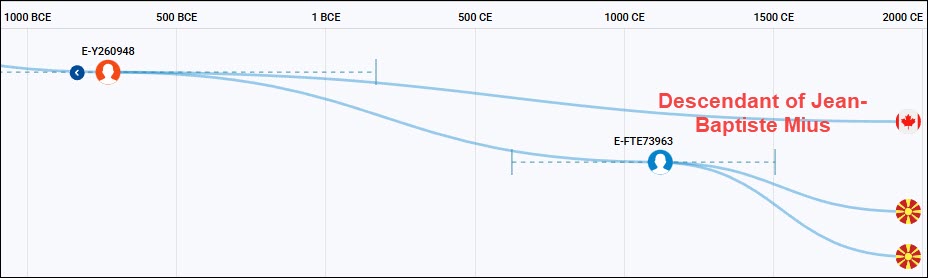
Using the Discover Timetree to review haplogroup E-Y260948, we discover that there are two men who have a descendant haplogroup from our Mius haplogroup.
Haplogroup E-FTE73963 split from E-Y260948 sometime between 2700 years ago when our Mius haplogroup was born, and about 1200 CE when the descendant haplogroup E-FTE73963 originated. Today, the ancestors of the two men who have tested and belong to the descendant haplogroup originated in Macedonia.
This means that our Mius ancestor, and the two men with Macedonian ancestors shared an ancestor someplace around 2700 years ago.
This is getting very interesting.

Macedonia is a Balkan country and borders Greece, Bulgaria, Serbia, Albania and Kosovo.

The Discover Migration Map shows the path out of Africa for haplogroup E-V13, a parent haplogroup of our Mius haplogroup, E-Y260948. Those men migrated through Turkey, probably crossing from Asia to Europe at Istanbul, then moving across the Balkans. This map shows the general migration path for haplogroup E-V13. The circle indicates where E-V13 was located about 5200 years ago when that mutation first emerged.
The map reflects the genetically constructed haplotree which is informed by EKA (earliest known ancestor) locations of testers, Ancient Connections of sufficient quality, along with the least cost migration path from point to point. “Least cost” means that migrating people would select a protected valley with a water source over crossing dangerous high mountains.
The little brown trowels mark the locations of Ancient Connections which are archaeological excavations of burials. We’ll get to those in a minute.
Another tool, Globetrekker, provides more granular pathways for ancestors more recently than E-V13 but prior to migration to the Americas.

The Mius lineage split 10 times between when E-V13 emerged in the Balkans, 5200 years ago, and 2700 years ago when E-Y260948 is found in or near the southern border of Germany.
But the Mius line was from France – you might ask what are they doing in Germany. Good question. The software can only work with the information it has.
Remember that today there are only three men who have taken the Big Y-700 test and carry the mutation for E-Y260948, and two of them are in a downstream haplogroup found in Macedonia. The third, our Mius family representative, shows his earliest known Ancestor in Canada – so the only locations that Globetrekker has to work with for E-Y260948 with are the locations of its parent haplogroup E-Y3183, and Macedonia. France doesn’t even enter into the picture, although it clearly should. If multiple Mius men took the Big Y-700 test and entered France as their EKA location, that would modify the location of E-Y260948 in Globetrekker. Not to mention that we would likely receive a closer Mius-specific haplogroup.

According to Globetrekker, our Mius ancestor, two haplogroups earlier, crossed over the mountainous border between Italy, Austria and Germany sometime around 3500 years ago. As you can see, those three haplogroups are closely clustered in that region.
This is an important intersection, because as we will see, not everyone went in the same direction. Some clearly went on to France, some to eastern Europe, some to Macedonia, and some turned left and found themselves in Italy.

Between 2700 years ago, maybe in southern Germany, and 425 years ago in Saint-Martin-aux-Buneaux, the Mius family line made their way from the border region between Italy, Austria, and Germany to the cliffs of Normandy.
Is there anything in Discover’s Ancient Connections that might be enlightening?
Ancient Connections

Ancient Connections, which displays the results of burials from archaeological excavations, is one of my favorite features of Discover. I wrote about using Ancient Connections for genealogy in the article, Ancient Connections: Where Archaeology Meets Your Ancestors.
We may not know where our ancestors were at a specific point in time, but we absolutely know when and where these people died and were buried.
There’s always an untold story just waiting for us – before surnames were adopted and written records became available. The record we are reading now is genetic.
With the free version of Discover or if you have not taken the Big-Y test, you can view about 10 Ancient Connections for the haplogroup you enter.

When clicking through from Big Y-700 results to Discover, you’ll see the closest 30 or so Ancient Connection matches, with the closest being shown first, plus the most ancient match in the database shown last
I encourage everyone to read each of the academic papers listed under “Reference” for each Ancient Connections sample to learn more about the culture and grave goods of each excavation.
As you receive closer matches, your more distant matches roll off your Ancient Connections match list.
I created a table few weeks ago, but several new matches have since been added, while an equal number of more distant matches fell off the end. Note that the samples styled as I###### are from the massive Ikbar paper that includes just under 16,000 ancient genomes from West Eurasia, Europe, and the Middle East, and stands to double the number of Ancient Connections. FamilyTreeDNA is processing this information as rapidly as possible. Some of the information about the burials is still embargoed by the authors.
One of the reasons I maintain a table is so that I don’t lose track of the information as new samples are added.
| Location | Their Haplogroup | Age/Culture | Shared Haplogroup | Haplogroup Age/ Birth Location |
| Rathewitz, Burgenlandkreis, Saxony-Anhalt, Germany | E-A7136 | 500 CE – Thurnigan culture | E-Y3183 | 3450 years ago. Probably in Germany |
| I465561 (no further information yet) | E-Y3183 | E-Y3183 | 3450 years ago. Probably in Germany | |
| Altheim 157, Altheim, Biberach, Baden-Württemberg, Germany | E-BY152516 | 400-800 CE, Medieval German culture | E-Y3183 | 3450 years ago. Probably in Germany |
| Rákóczifalva–Bagi, Szolnok, Hungary | E-BY152516 | 650 CE – Avar culture | E-Y3183 | 3450 years ago. Probably in Germany |
| Hajdúnánás, Hajdú-Bihar County, Hungary | E-A7136 | 725 CE – Avar | E-Y3183 | 3450 years ago. Probably in Germany |
| Csokorgasse 79. Wien-Csokorgasse, Vienna, Austria | E-BY5293 | 600-900 CE Avar | E-Y3183 | 3450 years ago. Probably in Germany |
| Rákóczifalva–Bagi, Szolnok, Hungary | E-BY40534 | 800 CE – Avar | E-Y3183 | 3450 years ago. Probably in Germany |
| I37963 (no further information yet) | E-Y3183 | c 850 CE | E-Y3183 | 3450 years ago. Probably in Germany |
| I37965 (no further information yet) | E-Y3183 | c 850 CE | E-Y3183 | 3450 years ago. Probably in Germany |
| I38363 (no further information yet) | E-Y3183 | c 1000 CE | E-Y3183 | 3450 years ago. Probably in Germany |
| Śródka, Poznań, Greater Poland, Poland | E-Y3183 | 1100 CE – Slavic | E-Y3183 | 3450 years ago. Probably in Germany |
| Tjærby, Randers, Denmark | E-Y3183 | 1200 CE – Medieval Danish | E-Y3183 | 3450 years ago. Probably in Germany |
| Korolówka, Ternopil Oblast, Ukraine | E-A7136 | 1250 CE – Old Ruthenian culture | E-Y3183 | 3450 years ago. Probably in Germany |
| Coimbra 23241, Castelo de Montemor o Velho, Coimbra, Portugal | E-Y3183 | 1550 CE – Historical Portuguese | E-Y3183 | 3450 years ago. Probably in Germany |
| I41604 (no further information yet) | E-BY116895 | 1750 CE | E-Y3183 | 3450 years ago. Probably in Germany |
| I43570 (no further information yet) | E-Z16659 | c150 CE | E-Z16659 | 3500 years ago, Probably in Austria |
| Gerulata 21935, Gerulata, Bratislava, Slovakia | E-BY5499 | 230 CE – Roman Age Slovakian | E-Z16659 | 3500 years ago, Probably in Austria |
| I42272 (no further information yet) | E-Z16659 | c 300 CD | E-Z16659 | 3500 years ago, Probably in Austria |
| I42273 (no further information yet) | E-Z16659 | c 300 CD | E-Z16659 | 3500 years ago, Probably in Austria |
| Masłomęcz, Polesia, Poland | E-Z16659 | 300 CE – Wielbark Culture | E-Z16659 | 3500 years ago, Probably in Austria |
| Béndekpuszta, Hács, Hungary | E-FT109005 | 475 CE – Gothic | E-Z16659 | 3500 years ago, Probably in Austria |
| Crypta Balbi, Rome, Italy | E-Z38770 | 500 CE – Roman | E-Z16659 | 3500 years ago, Probably in Austria |
| Kettőshatár I, Kiskundorozsma, Hungary (3 samples) | E-B Y193951 | 675 CE – Middle Avar | E-Z16659 | 3500 years ago, Probably in Austria |
| Wien-Csokorgasse, Vienna, Austria | E-L241 | 750 CE – Avar | E-Z16659 | 3500 years ago, Probably in Austria |
| Rákóczifalva–Bagi, Szolnok, Hungary | E-MF657677 | 750 CE – Avar | E-Z16659 | 3500 years ago, Probably in Austria |
| Székkutas 70, Kápolnadűlő, Székkutas, Hungary | E-BY5617 | 775 CE – Late Avar | E-Z16659 | 3500 years ago, Probably in Austria |
| Líbivá, Břeclav district, Southern Moravian region, Czech Republic | E-MF657677 | 725 CE – Medieval Moravian | E-Z16659 | 3500 years ago, Probably in Austria |
| Cifer-Pac, Trnava, Slovakia (2 samples) | E-BY199965 | 875 CE – Slav Avars | E-Z16659 | 3500 years ago, Probably in Austria |
| Końskie, Świętokrzyskie voivodship, Poland | 1100 CE – Slavic | E-Z16659 | 3500 years ago, Probably in Austria | |
| Groenmarkt-2, Sint-Truiden, Limburg, Belgium (Flanders) | 1325 CE – Flemish cultural group – died from Black Death | E-Z16659 | 3500 years ago, Probably in Austria |
To help organize this information meaningfully and understand what these samples and haplogroups mean to our research, I created a descendancy spreadsheet using the Ancestral Path and Ancient Connections.

The Ancestral Path in Discover shows the genetic path from the tester’s haplogroup directly up the tree.
Many of the Ancient Connections belong to branches off of our upstream haplogroups, not terminating with those haplogroups themselves. That’s fine, but it’s an important distinction because those individuals found on branches cannot be our ancestors.
Haplogroup E-Y260948, our Mius haplogroup, formed about 700 BCE, or about 2700 years ago and the next upstream haplogroup, E-BY174450 was formed about 3300 years ago.
Before that, E-Y3183 was formed about 3450 years ago, and so forth.
I started with Philippe Mius at the bottom of the spreadsheet, and built my way “up”, meaning back in time. The apricot column is the trunk of the tree, from which branches can form.

The first thing I wanted to know was whether our Mius line could potentially be descended from any of these burials. I wrote about this more broadly in the article, Ancient Connections: Where Archaeology Meets Your Ancestors.
There are always four things to consider:
- When the haplogroups were formed
- When the people lived, as compared to haplogroup ages. If the burial lived 200 years ago, but my ancestor lived 300 years ago, my ancestor is clearly not descended from the burial.
- Location
- History
In our spreadsheet, the branched lines with their haplogroups are in blue, so they are our haplo-cousins, and our Mius line cannot descend from them. We can only potentially descend from someone whose haplogroup is found in the apricot trunk column.
The samples in the apricot column have the same haplogroup as our Mius ancestor. However, a new mutation, E-BY174450 formed in the Mius line, so unless these men who are members of E-Y3183, lived BEFORE E-BY174450 was formed about 3300 years ago, then we cannot be directly descended from them either. None of these burials date between 3432 years ago when E-Y3183 was formed, and 3300 years ago when E-BY174450 was formed, so we cannot descend from any of these burials
However, and his is a BIG HOWEVER, that does not mean that all is lost, because the cumulative information in these ancient burials carries a story, especially when viewed together.
History is our friend.
History
Let’s look at the history of the region and the burials.
Rome conquered Gaul, which was comprised mostly of Celtic tribes at that time, about 2000 years ago, establishing their capital at Rouen in what is now France. The Romans killed one third of the population and enslaved another third, leaving only about one third of the families in their homes and not displaced. The enslaved people served individual Roman soldiers and worked on the Roman villas and estates, providing essential services, sometimes alongside free peasants and tenants. Roman villas and fortifications were found in upper Normandy, along the coast, where trade once occurred with England.
Late in the fourth century, Roman power waned. In 486, the Franks consolidated power after battling throughout what would become Normandy with Saxons and Germanic tribes. The Franks adopted Roman customs and controlled the land until the Vikings invaded in the 9th century. The Vikings also converted to Christianity, adopting the Frankish language, laws, and many customs, and became Normans.
In 1066, William the Conqueror, Duke of Normandy, invaded England, launching a period of Norman rule that began when William was crowned King of England. English monarchs ruled both England and Normandy until 1204, when Normandy was recaptured from English rule. Normandy was controlled once again by France until the Hundred Years War when hostilities erupted between England and France.
You can see from this history that France, and Normandy in particular, became quite the melting pot.
Viewing the Ancient Connections of the Mius line, in combination with haplogroup E-Y260948, which is of African origin, it becomes clear that our Mius ancestors weren’t Vikings, very probably weren’t Celts, probably not Angles, Saxons, or Danes either.
That leaves the Franks and the Romans.
Working backwards in time by haplogroups:
- E-BY4877, born about 4400 years ago has two testers from Italy,
- Moving further back in time to about 5200 years ago with E-V13, we find testers and burials in Italy, Greece, Turkey, Serbia, Croatia, along with the Slavic and eastern European countries, as well as Germany, Austria, and Ukraine.
- By 9500 years ago, we have a present-day tester from Egypt, with ancient burials in the same locations as before, but by 13,000 years ago, with haplogroup E-Z1919, we begin to see Ancient Connections in Jordan and Sudan.
The further back in time, the fewer burials that are contemporaneous. Most are much more recent.
The majority of the burials the Mius line is related to are Avar, although we do see some identified as Roman, Goths who raided Roman territory, the Weilbark culture associated with the Goths, Slavs who intermixed with the Avars, the Thuringians who were Slavs and overtaken by the Franks, and the Old Ruthenian culture which was Slavic and Baltic.
Based on the history of our haplogroup, and the history of the settlement of the northern-most portion of Normandy, it looks like our ancestor probably either arrived with the Romans who conquered the Gauls, or with the Franks who conquered the Avars and Slavs and took control of future-Normandy from the Romans.
There seem to be four potential ways our ancestors arrived in Normandy. The first two seem more likely than the bottom two:
- As Avar slaves to the Franks who displaced the Romans
- As a Roman soldier
- As conquered Gaulic slaves to the Romans, which is unlikely given that the Gauls were a Celtic tribe
- As slaves to the Romans, brought with them from Italy. While the Romans did travel with slaves, some of whom were conscripted into battle, in the case of the Gauls, they simply enslaved them instread of bringing their slaves from Rome.
There seems to be a lot of Avar history in our Ancient Connections, so let’s pull on that thread for a minute.
Avars
Wikipedia tells me that there are two groups of Avars. One group is a mountainous ethnic group that currently resides in the North Caucasus, between the Black and Caspian seas.
That doesn’t seem to fit, so let’s look at the other Avar group.
The historic Pannonian Avars are defined as an alliance of several groups of Eurasian nomads of various origins, spanning the Pannonian Basin and parts of Central and Eastern Europe. Yep, that’s the right group.
The Avars are first found on the Pontic-Caspian Steppe as a group of people who were trying to escape the rule of the Göktürks and greatly influenced the Slavic migrations to the Balkans.

By Wario2 – Own workOmeljan Pritsak The Slavs and the Avars. The victorious refugees established themselves in the Northern Caucasus, near the Byzantine holdings in the Crimea. In 558, through the good services of the Alan ruler, they established relations with the Byzantines and soon were granted the status of foederati on Byzantine territory in Scythia Minor, that is, Dobrudja, CC BY-SA 4.0, https://commons.wikimedia.org/w/index.php?curid=124091844
The Avars were a nomadic Central Asian Turkic Steppe tribe of warrior horsemen who controlled the Danube and Carpathian Basin, primarily in modern-day Bavaria, Hungary and Austria.
In both the maps above and below, please note the proximity of the regions where our haplogroups were found, near the border of Italy, Austria and Germany.

By Ramsey Muir – Muir’s Historical Atlas–Mediaeval and Modern ( London, 1911), Public Domain, https://commons.wikimedia.org/w/index.php?curid=17019845
The Franks appeared in Central Europe during the 3rd to 5th centuries. They joined ranks with the Romans to defeat Atilla the Hun in 451, then settled in Normandy after the Romans had abdicated power in 486. The Franks then conquered the Avars between 788 and 803 CE. The Avars converted to Christianity and were assimilated into the Frankish kingdom as vassals, generally in the Southeast part of France where the Avars lived when it was their territory.
The Romans
It’s worth considering that our ancestor may have arrived with the Romans, either as a soldier or as a slave, although arriving as a slave is probably less likely. Romans simply enslaved the Gauls, who had not assimilated the Avars or Slavs, as they had not yet moved that far east.
A more likely possibility is that our ancestor was a Roman soldier. In the early history of the journey of the Slavs, and with them some branches of haplogroup E, across Asia, Eurasia, and Europe, it’s clear that some Avars and Slavs settled in Italy. At that time, Rome was the largest urban center of the ancient world and controlled territory on three continents spanning the Mediterranean shores – including Italy and Istanbul, which was then Constantinople. Rome traded extensively with North Africa, so finding haplogroup E is not uncommon among Italians.
There is one burial found in a crypt in the center of ancient Rome, dating from 500 CE, which is after Rome conquered Gaul. This burial could have been from a descendant someone brought back to Rome from what would eventually be Normandy. Or it could have been a descendant of a man who turned left and went to Italy when his cousins turned right and continued on into Europe.
Hopefully future burials and testers will clarify the migration path of our Mius ancestors.
Whether Roman or Avar, it appears that our ancestors were probably in bondage one way or another in Medieval France, if not before.
Regardless of how they arrived, they stayed. In Medieval France, control of peasants was baked into the land, and when we find the Mius men in 1702 in Theuviille-aux-Maillots, they were not bourgeois or lesser nobility.
The Roman and Frankish system of slavery gradually transitioned into serfdom, then into feudal estates. The serf was literally owned with the land and could do nothing, including marry, without their owner’s permission. They were sold with the land.
Serfdom was abolished in 1315, but feudal society continued.
In the somewhat less restrictive feudal society, choices and movements were still controlled by the landowner, but not to the same degree. Labor was exchanged for protection. The seigneur of the manor still controlled the peasants and workers who lived on their land, dispensed justice, and ruled over their mini-kingdom, small though it may have been.
The Avar history is tightly interwoven with Eastern European peoples, but it is impossible without additional information to sort this out further. As more burials are discovered, and more men test, we’ll be able to refine our knowledge.
The Mius Line
Our Philippe Mius unquestionably arrived in Acadia from France, and two contemporaneous sources tell us that he was from Normandy. This information combined with Y-DNA test results and Norman history tells us a lot about how and when his ancestor likely arrived in France. It also eliminates several possibilities.
- He’s not Jewish.
- He’s not Anglo or Saxon.
- He’s not Viking.
He’s most likely:
- A Roman soldier, or a slave brought with a Roman soldier from Italy
- Frankish via the conquered Avars
A lesser possibility is that he was a Roman slave taken in Gaul, but that’s significantly less likely because the Gauls were Celtic, not Slavic.
Thanks to our Big Y-700 tester and the anonymous French Mius man who tested all those years ago, we know that Philippe Mius and the men who lived in Theuville-aux-Maillots and Saint-Martin-aux-Buneaux on the Norman coast shared ancestors sometime since the adoption of surnames, which probably occurred in the 1300s or 1400s, during the time of feudalism.
The Norman tester’s ancestors didn’t move far, only from field to field, about 5 miles in hundreds of years – and their descendants continue to farm the same fields just above the cliffs.
Philippe Mius boarded a ship and sailed for Acadia in 1651. It would take another 360+ years to reunite the two lines of the Mius family, thanks to Y-DNA testing.
In the greatest of ironies, in far distant Acadia, in 1653, Philippe Mius d’Entremont became a seigneur himself, owning and controlling the land of the people who farmed and lived in and around Pobomcoup, today’s Pubnico. In 1671, the census shows us that there was no one living there except his wife and children, but by the mid-1750s, when the Acadians were expelled by the English, his seigneury had expanded to include about 300 people, most of whom were his descendants.
Beautiful Normandy
Cousin Mark did a deep dive at Filae for us, slogging through myriad unsourced trees and other information, first focused on Theuville-aux-Maillots and Saint-Martin-aux-Buneaux. He then expanded to other regions along the Norman coast, then expanded again to anything within 200 km. After slogging through more than 660 trees looking for actual sources, he was able to confirm that there were Mius families along the Norman coast in the Seine-Maritime department in the early and later 1700s. One 1745 burial was from as far north as Steenwerck in French Flanders.
He was not able to reassemble families, and of course, we don’t know if all of those people were part of the same Mius family. Some unsourced trees did reach back into the mid-1600s.
Mark mentioned that Filae includes very few original records from the 1600s, depending instead on local genealogical societies to transcribe parish records and post them in large, reassembled trees. Unfortunately, that has not happened with the Norman records we need, but hope springs eternal.
Thanks to Philippe Mius’s descendants’ Y-DNA matches, we know that our Mius family lived in Theuville-aux-Maillots in the early 1700s and very probably neighboring Saint-Martin-aux-Buneaux in the early 1600s. We also know that moving from place to place was difficult, if not impossible, and that our shared ancestor lived sometime after surnames were adopted in Normandy. This narrows that timeframe to 1300-1400 CE, 200 or 300 years prior to the early 1600s when Philippe was born.
We also know that the Mius family still resides just above the Norman coastline, farming those ancient fields, within easy walking distance of Saint-Martin-aux-Buneaux.
There’s no question that we belong here, in beautiful Normandy!
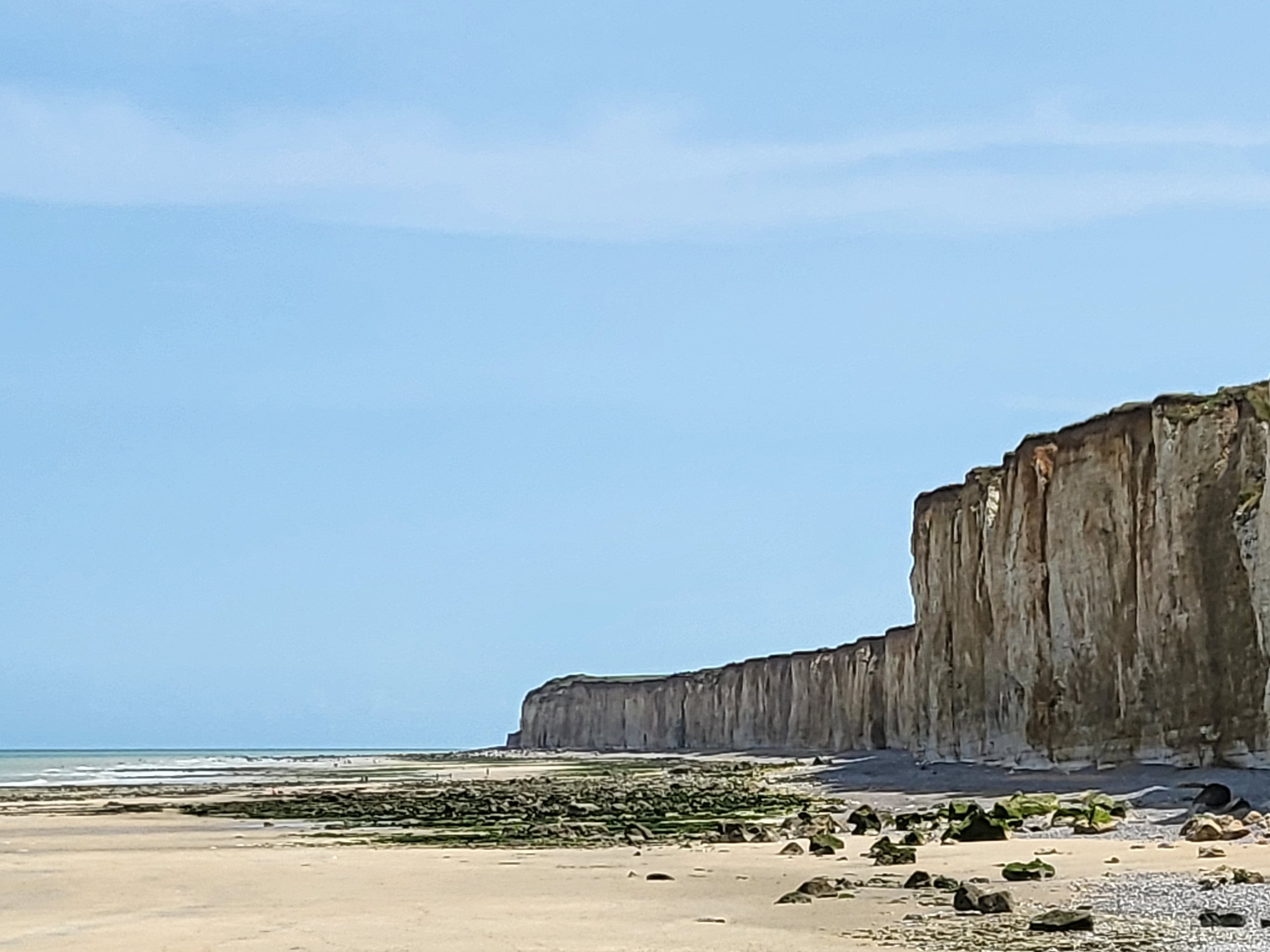
As fate would have it, Mark traveled in that region a few years ago and was kind enough to share his stunning photos of the cliffs along the Norman coast. I’d like to thank Mark for his research and photos.
Please let these photos transport you back in time as you think about the lives of our ancestors as they established their homes here.

Courtesy of Cousin Mark
Saint-Valery, Varengeville-sur-Mer
Courtesy of Cousin Mark
Veules-les-Roses

Courtesy of Cousin Mark
Varengeville sur-Mer

Courtesy of Cousin Mark
Pourville sur-Mer
_____________________________________________________________
Share the Love!
You’re always welcome to forward articles or links to friends and share on social media.
Subscribe!
If you haven’t already subscribed, it’s free. You’ll receive an e-mail whenever I publish by clicking the “follow” button at the top of the main blog page, here.
Help Keep This Blog Free
I receive a small commission when you click a vendor link in my articles and purchase that item. This does NOT increase your price but helps me keep the lights on and this informational blog free for everyone. Please click on the affiliate links in the articles or to the vendors below if you are purchasing products or DNA testing.
Thank you so much.
DNA Purchases and Free Uploads
- FamilyTreeDNA – Y-DNA, mitochondrial and autosomal DNA testing
- MyHeritage DNA – Autosomal DNA test
- AncestryDNA – Autosomal DNA test
- AncestryDNA Plus Traits
- 23andMe Ancestry – Autosomal DNA only, no Health
- 23andMe Ancestry Plus Health
Genealogy Products and Services
- MyHeritage Subscription with Free Trial
- Legacy Family Tree Webinars – Genealogy and DNA classes, subscription-based, some free
- Legacy Family Tree Software – Genealogy software for your computer
- OldNews – Old Newspapers with links to save to MyHeritage trees
- MyHeritage Omni comprehensive “everything included” subscription plan
- Newspapers.com – Search newspapers for your ancestors
- NewspaperArchive – Search different newspapers for your ancestors
My Books
- DNA for Native American Genealogy – by Roberta Estes, for those ordering the e-book from anyplace, or paperback within the United States
- DNA for Native American Genealogy – for those ordering the paperback outside the US
- The Complete Guide to FamilyTreeDNA – Y-DNA, Mitochondrial, Autosomal and X-DNA – for those ordering the e-book from anyplace, or paperback within the United States
- The Complete Guide to FamilyTreeDNA – Y-DNA, Mitochondrial, Autosomal and X-DNA for those ordering the paperback from outside the US
Genealogy Books
- Genealogical.com – Lots of wonderful genealogy research books
- American Ancestors – Wonderful selection of genealogy books
Genealogy Research
- Legacy Tree Genealogists – Professional genealogy research