
Jeanne Chebrat is somewhat of a mystery woman. Ironically, we know when and where she was born in France, but we know very little about her life in Acadia. That’s the inverse of what we normally find.
Life in La Chaussée
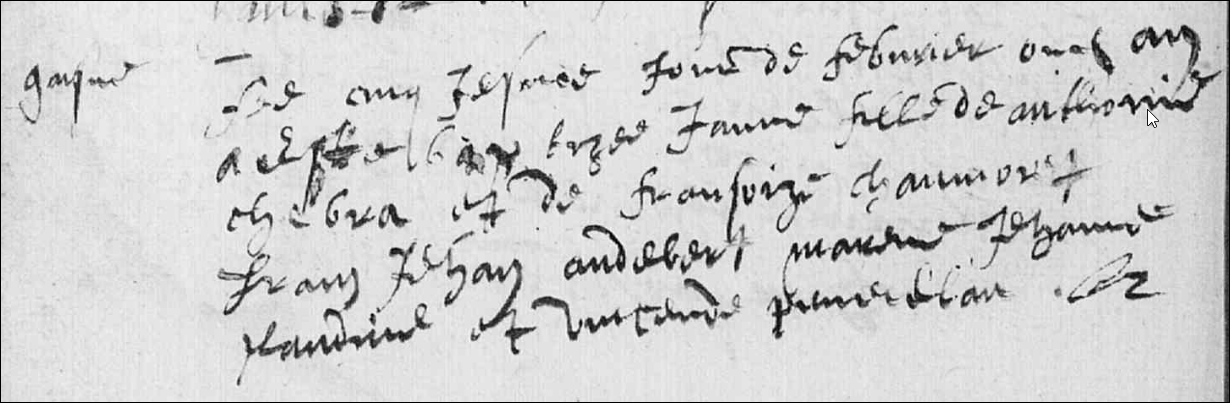
Jeanne was baptized at Notre-Dame de La Chaussée on February 5, 1627. The registry with her baptism is found in the archives of Deux-Sevres et de la Vienne.
Jeanne Chebrat or Chebrot was born to Antoine Chebrot or Chebrat and Françoise Chaumoret. Her baptism record doesn’t give her birth date, but Catholic babies were typically baptized the day they were born, if possible, or as quickly thereafter as possible otherwise.
Jeanne’s father was a merchant miller, “marchand meunier,” a tenant miller according to notarial records, who would have been contracted to Charles de Menou d’Aulnay or his family, the seigneurial family who owned the land.
Typically, the miller leased the mill and lived adjacent to or nearby the mill. He had to be there when farmers dropped off their grain, to grind it, then for them to take it back home as flour or meal after grinding.
There wasn’t an actual mill at or near the village of La Chausee, but the d’Aulnay family owned land across multiple parishes. Charles de Menou d’Aulnay’s mother, Nicole de Jousserand, held seigneurial rights that linked lands across Martaize, Saires, Guesnes, and La Chaussée. Church tithing borders also shifted over time. Towns today were small villages back then, linked to other hamlets by dirt roads across an agricultural landscape.
Furthermore, Cardinal Richelieu had created a patchwork of churches and investors, and sometimes the traditional rules were applied selectively.
Therefore, we don’t know exactly why Jeanne Chebrat was baptized at La Chaussée in the winter of 1627, and her sister, Mathurine, was baptized at Saint-Vincent just 33 months later. Today, Saint-Vincent is represented only by its cemetery, now called Cimetière de Monts-sur-Guesnes in Monts-sur-Guesnes.
There were only a few windmills that occupied the ridges where their sails could catch the wind. We know that in 1650, Antoine Chebrat ran the La Chaussée windmill, but based on other records we have, he served as a miller at other nearby mills earlier. Other mills were found near Saint Vincent, still within the larger group of d’Aulnay seigneurial lands, which could explain the 1629 baptism location.
Regardless of which mill her father ran in 1627, the church at La Chaussée, where Jeanne was baptized, was 5 or 6 miles away. And it was early February.
February in the Poitou
February in the Poitou is characterized by shifting, raw winds averaging about 10 or 11 MPH and primarily blowing from the south and southwest. For a miller, this was wonderful, a gift, enabling him to grind the winter grain before the spring rains and dampness arrived.
But for a newborn infant, not so much.
February brought freezing conditions with temperatures dropping into the low 30s (°F) overnight. While it wasn’t cold enough to completely lock up major rivers with solid sheets of ice, thick morning frost and ice were found along the edges of the smaller stream banks like Le Milleron and La Briande. This meant valley millers with water mills had to spend their early mornings manually clearing ice off their wooden waterwheels to prevent the paddles from cracking or freezing solid. And sometimes the small streams did freeze, grinding everything to a halt.
The skies were gray and depressing, with clouds covering the sun about three-fourths of the time during the winter months. Cold rain, sleet, and light snow showers would have saturated the dirt tracks between La Chaussée, Saint Vincent, and the various mills in the commune of Saires and Guesnes. Transporting heavy sacks of grain from the muddy valley fields to the windmills via pack-mules or ox carts would have been slow, treacherous, and dangerous work during this time of year. The miller’s wife probably welcomed chilled farmers into her kitchen with something hot to drink and a seat beside the fireplace.
Then, in the midst of winter, Jeanne was born, and Antoine needed to take his newborn baby girl to the church for the sacrament of baptism.
The baby would have been carefully wrapped to keep her warm. Even in the best case, under those conditions, the trip would have taken two to three hours each way. The journey would have been treacherous, especially descending steep ridge slopes into the valley with a newborn. The wagon didn’t dare tip over or become mired in the mud.

Even today, the streets of tiny La Chaussée are unpaved, and these same buildings would have been standing in 1627 when they passed by.
Sometimes, especially with a difficult birth, the mother didn’t accompany the child to be baptized, but with a trip like this, Françoise wouldn’t have had a choice. Someone had to feed the baby and care for her on the trip to and from the church.
Maybe they stayed overnight with a local couple who lived in the village right by the church.
Perhaps someone had ridden ahead to alert the priest to be prepared. He probably wouldn’t normally have been at the church on a Friday, although he likely lived next door. He might have been called away, though, to provide comfort or last rites.

Jeanne’s parents were probably terribly relieved to see the steeple appear on the horizon in the distance.

The church stood adjacent to the walled courtyard with houses that opened into the center where they shared the well.

Jeanne’s parents would have entered through the rear portico.

The doorway opened into the stairwell descending into the nave.

Antoine would have helped Françoise, who had just delivered their daughter, down the precarious steps.

Churches weren’t heated then, so the priest would have warmed the Holy Water a bit for the baptism.

When I stood here, I didn’t realize that my ancestor had been baptized in this very place. That I was standing where her parents had stood on that Friday in February.

In this photo, Claude is welcoming us back home some 397 years after Jeanne was baptized here. Antoine and Françoise would have stepped up onto this altar, carrying their baby oh so carefully.
Beneath their feet were these same stones, worn smooth over the ages by thousands of the faithful. Their ancestors probably walked here too.
The church, on that cold February day, had already witnessed 500 winters, and maybe more. Built along the old Roman Road, more than 20 generations of French peasants who lived in the village and nearby hamlets had been baptized, married, and committed into consecrated ground here.
But on this day, Antoine and Françoise were baptizing the child who would become one of the founding women of the New World, of Acadia.
Their blood and hers still run in thousands of their descendants who trace their lineage back to this beautiful, quaint church that sheltered so many.

Françoise and Anthoine probably crossed themselves in thanksgiving for their safe arrival. If God deemed that they should die on the way home, at least their baby’s soul was protected.

This timeworn Madonna greeted them, holding her child.

This church is connected to multiple Acadian families. Deceased Acadian historian, Stephen A. White wrote that in 1662, Jeanne’s sister Philippe Chebrat married a widower, René Mirgardiere, whose previous wife was Jeanne Breau, spelled Braud on this plaque mounted on the church wall.
Confusing Records
The only other baptism record we have for any of Jeanne’s siblings is that of her sister Mathurine Chebrat, who was born on November 8, 1629 and baptized in the parish of Saint-Vincent de l’Oratoire.
In the Catholic religion, while one could attend services at a convenient church, you were expected to return to your “home church”, meaning the one whose parish boundaries you lived within, for sacraments like baptism.
There were exceptions, of course, primary among them being that a child was in imminent danger of death. In this case, you didn’t need to go to any church – the midwife or anyone else could baptize the child until their own priest could supplement those rites.
Another possibility is that the weather was just too bad, or a road had washed out, allowing a priest in another parish to make an exception and baptize an infant.
So, we don’t really know why Antoine’s children were baptized in churches just 5 miles apart. It probably had to do with the fact that he was a tenant miller to Charles de Menou d’Aulnay, whose home church was La Chaussée. Jeanne’s father, Antoine, may have moved from mill to mill as his leases expired, or d’Aulnay may have needed him temporarily at one mill or another.
We do know that d’Aulnay recruited heavily from his parish at La Chaussée for reliable, skilled French peasants to set sail for Acadia, today’s Nova Scotia. But he also didn’t limit his recruitment efforts to just La Chaussée.
Eventually, Jeanne was one of those recruits, probably as a newlywed with her husband, although we have no marriage record for her.
Let’s reconstruct what we can from what we do know.
The Mills
We know that in 1650, according to notarial records referenced by Stephen A. White, Jeanne’s father was the miller at the windmill of La Chaussée in the parish of Saires. Millers lived at or very near their mill, so this information is incredibly enlightening.
The mill referenced in the document is a windmill, not a watermill. Windmills must sit high enough that they can catch the wind in their sails, while watermills run on the waterpower of a stream and, by definition, streams run across the lowest points of the terrain.

Click to enlarge
According to both the Cassini map of the area, drawn in 1765, and the 1813 Napoleonic map, there were no mills in the parish of La Chaussée, which was low, but there were several in neighboring parishes, as indicated by the cluster of red arrows above.
The red circles at La Chaussée and St. Vincent are where Jeanne and her sister were baptized, respectively, and Guesnes is the location where the marriage contract of another sister, Philippe, says she was born. Aulnay, on the far left, above La Chaussée, is the manor house of Charles de Menou d’Aulnay, where his portion of the grain needed to be delivered.

In the neighboring parish of Saires, there were three sets of mills. The icons with sails represent windmills, and the little wheels represent water mills.
The windmills depicted are positioned along a ridge above companion watermills. Windmills need to be situated in a cleared area at a relatively high elevation, away from trees in order to catch the wind to drive the huge mill’s sails.
However, when the water runs low, or freezes, watermills can’t function, so windmills and watermills worked as companions to ensure that the grinding of grain could continue throughout the year.

The mills at and above Pincevent are actually called Moulin du Chaussée on the 1813 map. The windmill symbol beside the letter “K” marks the site uphill from the watermill. Neither exists today, but the home/farm structure at Pincevent where the miller probably lived does.
The mill at Renault is called Moulin Renault, and the road is still named after that mill. The homes and barns still exist.
The mill labeled Mn Balancauene in 1765 (or something like that) is gone today, but the tiny road called Moulin de Balamboene runs until it becomes simply an inaccessible farm path.
All three watermills are located on the stream named La Briande, with their companion windmill nearby.

The 1813 cadastral map of Saires shows very clearly the mill named Moulin du Chaussée where the La Briande stream crosses the road that is today D69, just Northwest of Pincevent N, along with the Moulin Renault less than a mile away.
La Briande translates to either “the high place” or “settlement on the ridge” or something like “the noisy rushing stream.” Perhaps all three were relevant to this stream, considering its source and that it supported several mills for miles across the French countryside.
While the name on the map is written at the stream intersection, a tiny drawing depicting a windmill is shown above that area at “K”, near a boundary line of some sort.
When I first studied these maps, trying to reconcile the locations between them, I didn’t realize that the 1813 map showed the only locations of homesteads, which were farm compounds at that time.
Typically walled in that era, these working farms included outbuildings – hence the unusual shapes. In other words, this map wasn’t just showing some of the places people lived – it showed all of the places people lived. Given that the miller had to live adjacent to or very near the mill, one of these was clearly the Chebrat family home, at least by 1650, and probably many years before.

The 1813 cadastral map of the Guesnes parish shows other mills that align with the Cassini map.

So does Monts-sur-Guesnes that includes St. Vincent, but since the Saires map specifically names one of the mills “Chaussée,” and the 1650 notarial record states that windmill is in the parish of Saires, the mill above Pincevent should be that mill. In fact, it’s the only reasonable candidate.

The La Chaussée mill is the closest mill to the village of La Chaussée that’s in the parish of Saire. The church at La Chaussée was about 5 or 6 miles away.

Jeanne’s father would have had to transport d’Aulnay’s share of the grain to his estate, another mile or so north of the village of La Chaussée. That path took him either through Saint Vincent or Guesnes, so he would have been quite familiar with those village locations too, and their respective millers.
Millers renewed their contracts every few years, so Jeanne’s father could have worked at any or all of them over time.
The neighborhood where Jeanne spent at least part of her childhood probably revolved around the mills that fell within the parish of Saires.

I’ve marked the Saires locations on this modern-day terrain map, where the higher grounds are shaded in light gray.
While I can’t pinpoint the exact location where Jeanne lived, the map itself narrows the possibilities. Let’s start with our best candidate, the ancient hamlet of Pincevent N, with only one farm compound – and that farm maps exactly to the 1813 cadastral map.

This homestead stood between the tiny cart path and the brook which snakes behind these buildings at the rear of the property. These buildings are certainly old enough, and are in the exact location on the map, to have been where the miller and his family lived.

Farms had to be self-sufficient, and typical for a farm of that era, the buildings closely lined the road.
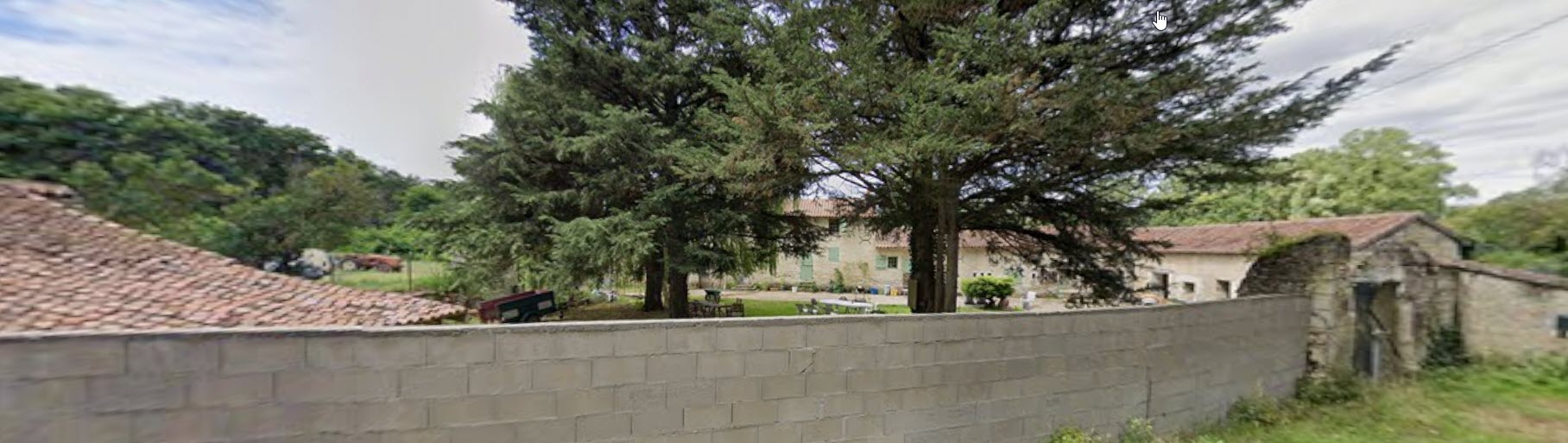
The original wall had apparently deteriorated to the point of no salvation – so a contemporary wall has replaced it.
My guess is that this is where the Chebrat family lived, at least in 1650, and Jeanne’s father tended both mills. It helped that his son was a miller too.

We can still see this beautiful French farm home that appears to be the original. Built from local Tuffeau limestone, and meant to last for centuries, it would have stood when Antoine Chebrat was the miller here.
Based on accumulated evidence, I believe this is where the family lived in 1650 and probably several years earlier as well.
I can picture Jeanne feeding chickens or playing under these trees in the courtyard.

The only other building is the neighboring farm named La Beuille, also ancient, and now an event venue, which you can view here. Those restored buildings are stunning and probably reflect what they looked like four hundred years ago if you use your imagination a bit.
This tiny road exits right at Moulin Renault, but instead, let’s take a drive along the path to the Chaussée windmill first.

La Briande Creek is actually quite small and has been contained in a culvert beneath the road. Its headwaters spring forth just a mile and a half away, above Moulin Balanbouene.
Crossing the little bridge, we see the location of the La Chaussée water mill where the creek crosses the road, up D69 to the intersection with D68, near where the Chaussée windmill stood.
Over the years, Antoine would certainly have been familiar with all of the mills, so Jeanne would have traveled this road too. She may have played in the yard as the local farmers dropped their grain off and enjoyed some local gossip, along with wine, as her father ground their grain.

Today, a few fields are still cultivated along these remote one-lane roads, but the forest has regrown over much of the land.
La Briande creek or brook runs beneath the highway here, more like a gulley, so the two little buildings shown on the north side of the creek would have been located in this field at right. The treeline is the stream.

Today there is no evidence of old structures here.

The “K” location marking the windmill, but with no buildings, is located further up this road. Homes needed access to fresh water, and there was none to be had on hilltops. The miller lived near the watermill below.
Only one building or home is located along this stretch today, at the intersection with D68. That home isn’t on the 1813 map, and certainly doesn’t appear to be more than 300 years old.

Using Google Street View, the location of the mill appears to be roughly here, near the intersection where these trees now stand.

Once again, no aerial evidence of a mill. The area is heavily forested.

I was looking for the telltale foundation and hillock where the mill once stood, but instead I found these beautiful sunflowers just beyond that intersection.
Of course, any trace may be gone now, or it may be hidden in the woodlands. Like the other mills, it would have stood near the road.

We can see this intersection on the 1813 map, so we’re turning towards Moulin Renault.
On the map below, follow the green arrows from Pincevent Nord past the La Chaussée mill sites and around the Moulin Renault loop and back home again.

A few hundred feet down D68, the tiny Moulin Renault loop road turns to the left. At that time, the entire purpose of this path would have been access to the mills.
Local historians have written about the windmill here, and the hillock that remains. The old foundation stones are now covered with bramble, brush and trees, but they know where it’s located.
On the Cassini map, this location also had a water mill, which makes perfect sense.

The original windmill was located at the red arrow. At that time, it rose above the landscape, but today what’s left of the foundation is obscured in a raised clump of trees and vegetation.

What could be a water mill on the 1813 map appeared to be spanning the La Briande creek.

At harvest time, local farmers would bring their grain in wagons and carts to the mill to have it ground. They had no choice. You had your grain milled in the seigneur’s mill, just like the miller had no choice but to share the bounty with the seigneur as well.

Following the curve shows the field behind the mound where the windmill once stood. The mound is on the right side of the photo, just left of the road.

Unless you know what you’re looking for, you’d never notice this rise, unless perhaps you discovered the old mill’s foundation stones.

A few disheveled stones are exposed today, but most are buried now.

The first farm, behind these buildings lining the road, sits directly across from the hillock. This was probably the watermill or its buildings.

Looking back towards the hill as we drive towards the next farm structures.

These buildings date from the same era.
Beyond the second farm enclosusre, we drive past a few fields and through the forest.

The verdant green of this second-growth forest shades the other end of the road where it intersects with D68 today. Within sight would be the sails of the Moulin Chaussée.

Spring in May is joyfully beautiful here. How Jeanne must have missed this.
Jeanne’s Family Members – It’s Complicated
To understand Jeanne Chebrat’s family in the Poitou, we need to follow the legal breadcrumbs left behind in Poitiers’ un-digitized notarial vaults. Because local village church records from this era are missing or incomplete, these French property agreements and notarial records sometimes serve to fill at least part of the gap – if we’re lucky.
In our case, we are somewhat lucky, because there was value in the miller’s leases and perhaps other personal property, so when either the husband or wife died, property distribution needed to be considered. Not only that, marriage contracts were drawn up when something of value was involved as well. Prenuptials are not a new thing!
These records reveal several siblings who functioned in a tightly knit family circle working together to navigate life, marriage, and the family milling business. If we had church records, we’d probably find them standing as godparents for each other’s children too.
I translated the page of Chebrat information collected by Stephen A. White and published in his long out-of-print book, Dictionairre Généalogique des Familles Acadiennes, which included information from 1650 and 1662 notarial bundles. the 1650 bundle number 4 E 26 128 can now be requested from the French archives and the 1662 one as well, number 4 E 26 140. I have requested both, so we’ll see what, if anything, arrives.
Bless that man’s heart for his years of in-depth research.
After I had completed this article, or so I thought, I discovered that White had published a correction in 2003, which I’ve incorporated here. Better before than after publication of this article.
Thanks to White’s research and that of others, Jeanne’s sibling network and part of her father’s family becomes clear, and with it, different chapters of Jeanne’s own pre-Acadian life.
- On January 30, 1650, Jeanne’s brother, Pierre Chebrat, drew up his marriage contract before the Poitiers notaries, Poyriet & Maxias, to marry Florence Lamoureux, which states that he, too, is a merchant miller. This would suggest Pierre’s age between 25 and 30, so maybe born 1620-1625.
Note that because the notaries were in Poitiers doesn’t mean that’s the location where the couple was married. People who lived in the small Poitou hamlets had their legal work taken care of in Loudun or Poitiers.
Pierre’s family members were apparently nearby or journeyed with him on this joyous event.
- François Chebrat signed as a witness on Pierre’s 1650 marriage contract. According to White’s correction, François had erroneously been identified as the brother of the groom, but, “According to J.-M. Germe, “Origine de la famille Chebrat” (“Origin of the Chebrat Family”), Les Amitiés généalogiques canadiennes-françaises, no. 10, 1999, pp. 27–33, François Chebrat was Antoine Chebrat’s brother, rather than his son, and Étienne Chebrat was François’s son.” This makes François Chebrat Jeanne’s uncle.
- Étienne Chebrat, the son of François, also stood as a witness for Pierre. He later left the family milling trade to become a master woodturner (marchand tourneur). His February 3, 1642 apprenticeship reportedly provides his family connections. The Société généalogique canadienne-française lists it as number 26835. The Vienne archives identify the notary Hélie Maxias’s 1642 minutes as 4 E 26 120. This makes Étienne Jeanne’s first cousin.
Twelve years later, on January 15, 1662, the family gathered again before the notaries Porcheron & Maxias in Poitiers. This time, it was for the marriage contract of Jeanne’s sister, Philippe Chebrat, who was marrying the widower, René Mirgardiere. Philippe’s contract explicitly notes that she was born in the town center (bourg) of Guesnes, proving the family’s movements over time.
If Philippe was roughly 20 when she married, as would be typical, she would have been born about 1642. This document notes that their father, Antoine, is now deceased and reveals another sibling, plus Pierre who we already know.
- Pierre Chebrat traveled to Poitiers to act as the primary family witness for his younger sister.
- Marguerite Chebrat, Jeanne’s sister, also stood as Philippe’s witness.
These documents, combined, suggest that Jeanne’s parents were having children from about 1620 to about 1642, placing her mother’s birth around 1600.
The Monkey Wrench
I hate to even breathe these words, but there’s another Jeanne Chebrat too, born in April of 1627. This is only possible in my worst genealogy nightmares!
The other Jeanne Chebrat was baptized in the city of Poitiers itself, at Saint-Hilaire-le-Grand.

On the fifth day of the said month [April 1627], Jehanne Chebrat, born to Savine Jacquet, of the parish of Sainte-Triaise, was baptized. The godfather was Mre Jehan Chebassier. The godmother was Andrée Jacquet. The said godmother declared that she did not know how to sign.
The entry names the baby Jehanne Chebrat, names Savine Jacquet as her mother, and gives Sainte-Triaise as the parish associated with her mother. That explains why Sainte-Triaise appears in some accounts even though the baptism is in the Saint-Hilaire-le-Grand register. As it turned out, not all churches had baptismal fonts, and Sainte-Triaise did not.

On Sunday, May 5, 1619 François Chebrat and Savine Jacquet were married at Sainte-Triaise in Poitiers.
I asked two AI agents, plus cousin Mark, to translate, and this is the best we can do, focusing on the main points, not all of the squiggles:
On Sunday, the fifth day of May, one thousand six hundred nineteen, I, the undersigned parish priest of Sainte-Triaise in this city of Poitiers, certify to whom it may concern that I married François Chebrat to Savine Jacquet, a parishioner here, at the entrance of the said church at about five o’clock in the morning, the solemnities of our Mother the Church having been duly kept and observed, in the presence of Mathurin Chebrat, father of the said groom, Pierre Chebrat, Jehanne [Braudelle?], Loyse [Hude?], Jehan Guillon, Honoré Mazereau, Jehan Courtois, Catherine des Neiges, Marie [Charpentier?], [inked-out text], [Laine Vinier?], and several others.
Margin note:
Chebrat, natif de Mirebeau (“Chebrat, native of Mirebeau”) and Jacquet, natifve de ceans (“Jacquet, native of this parish)
Signatures below the entry:
Honoré Mazereau, Jehan Courtois, Catherine des Neiges, and [Chandor?], followed by curé susdit (“the aforesaid parish priest”). Brackets mark uncertain or obscured readings.
Mirebeau is in the Vienne department of France, between Poitiers and Loudun. It’s about 16 miles (26 km) north-northwest of Poitiers and 10 miles (17 km) southeast of La Chaussée by road.
If all of this is accurate, then Mathurin Chebrat was from Mirebeau, as were his two sons, Antoine and François. This certainly explains why Antoine Chebrat named his daughter Mathurine. It’s a very unusual name.
It appears that the two Jeanne Chebrats were first cousins.
The Chebrat family, writ large, seems to have been associated with Poitiers, while Antoine Chebrat became a miller, and at one time, worked in the mills belonging to d’Aulnay – making his daughter the most likely candidate of the two Jeannes to have been recruited for Acadia.
I’m not alone in my thoughts about this. White believed that to be the case too. The La Chaussee connection with d’Aulnay, and his recruitment for Acadia are the primary factors, so let’s move ahead with Jeanne’s life as best we can.
Jeanne’s Marriage
Unfortunately, parish records are missing in both La Chaussée and neighboring Martaize, where some think that Jeanne’s probable first husband, Jean Poirier’s family lived. French historian Geneviève Massignon, in her 1962 book, stated that Jean may have come from the Martaize area because Poirier appears, with the surnames of other Acadian settlers, among the censistaires, tenants paying taxes, to the estate of Charles d’Aulnay’s mother. Martaize, La Chaussee and Guesnes are all within four or five miles of each other, and the peasants wouldn’t necessarily have lived in the towns.
Clearly, we don’t know, but if Jeanne’s sister was born in the small “village of Guesne” around 1642, that would have been where Jeanne was living then too.
An old monastery and abbey once stood at Guesnes, and the town formed around them, along with two windmills.
Let’s take a little tour of the area.

This ancient church at Guesnes, on the road that’s still dirt, served as the monk’s chapel in the 1640s.
It wasn’t until 1671 that an agreement between the curé of Dercé and the priory at Guesnes granted permission to open a door towards the village so residents could attend mass here.

So while the Chebrat family probably passed this building often, it’s not where they attended church, not where their baby would have been baptized, nor where Jeanne Chebrat would have been married about the same time.
Philippe’s 1662 marriage record explicitly states that she was born in “le bourg,” the village, of Guesnes.
The 1765 Casini map shows mills here, and the 1813 cadastral map shows us two mills, both labeled.
The upper mill says “Moulin du vent,” windmill, then slightly to the right, we can see Moulin de Pain Perdu.”
The lower mill, shows an icon for a windmill, with the label beneath the La Briande stream which is labeled Moulin de Bay. Nothing is left of that mill or buildings today. The map of neighboring commune Monts-sur-Guesnes shows the actual Moulin de Bay, at least the water portion, just over the border. So if Philippe Chebrat was born in the village (bourg) of Guesnes, it would likely have been at the Moulin de Pain Perdu, not in the neighboring commune.
A “pain perdu” mill, means literally “lost bread” and is a metaphor referring to the financial ruin of the miller due to an intermittent or too small stream that made a water mill unreliable.
Because a miller’s entire livelihood depended on grinding grain into flour to make bread, a mill that stood idle meant no flour, no income, and no food. The investment and the labor were considered “lost bread,” wasted effort and lost sustenance.
This name could have been applied historically, because, as we see on the map, there is also a windmill to augment the watermill.

On today’s Google satellite view, using that three-pronged intersection as our anchor, we can clearly see the remains of the foundation of the windmill in a field. There’s no question about what this is. It aligns perfectly.
At the bottom of the image, we see the location where the stream crosses the road, which is the location of the mill labeled “Pain Perdu” which looks to span the creek.
This is the only candidate location for a home beside a mill location. Let’s see what’s left today.

Approaching the stream from the east, we can see the tiny brook with its little bridge. Of course, the mill race is gone today, but the evidence of it is not.

This building was probably part of the mill itself, tucked up against the creek. The heavy, finely dressed limestone blocks (pierres de taille) reinforced the corners of the building. This is classic 17th/18th-century Poitevin construction designed to withstand the immense vibrations and structural stress of a heavy waterwheel and turning millstones inside.
The corner blocks were staggered in their placement for additional structural reinforcement. This was not decorative. In watermills, the weight of the turning internal mechanism (the pit wheel, wallower, and massive stone grinding wheels) transferred immense kinetic energy into the structural frame. Without ashlar limestone blocks anchoring the building’s corners to lock the loose rubble-stone walls together under tension, the vibrations would cause the mortarless or weak-lime walls to slowly bow out and collapse.
The building is tucked down near the stream bed, utilizing the natural slope of the landscape to let water gravity-feed directly into or under the lower level where the wheel turned. That portion is gone today.
I’m not sure if this was actually the mill, or a secondary building while the mill itself crossed the actual stream. The stream channel may have been rerouted a bit, too.

I’d sure love to see this up close and personal. Jeanne’s sister, Philippe, was probably born here, and Jeanne would have lived here too.

It’s difficult to see into the farm compound today, but parts of the other buildings remain, while being shored up with modern materials.
I can see the local farmers with their carts pulled by oxen arriving with their grain. Perhaps the oxen got tied up by the barn and received some oats or maybe some barley while the men went about their business.

I don’t know if the current owners know this used to be where the local miller lived, but it’s still a working farm.

Looking across the road, which would have been a dirt path in the 1640s, we see the field that the Chebrat family would have seen. Then, grains were probably being grown here to be ground at the mill.
The church was not nearby. It didn’t matter how far they lived from their parish church, the family would have traveled there for Philippe’s baptism. Guesnes had both a monastery and an abbey, but the church that served the villagers was in the commune of Dercé.

Antoine and Françoise would have visited the Dercé parish church, five miles further north. You can see the interior, here. I’m struck by how much this church resembles the one at La Chaussee.
Given that Jeanne’s sister, Philippe, was born in “le bourg” of Guesnes, she assuredly was baptized here. Did her parents stand inside this building with her sister, Jeanne, as she married Jean Poirier, too?
Young French women generally married between 16 and 20, which would have placed Jeanne’s marriage sometime between 1643 and 1647, probably in France.
If Jean Poirier was her husband, that means that Marie Françoise Poirier, born about 1648, and Michel Poirier, born about 1650, were her children.
If Jean Poirier was Jeanne’s first husband, and Antoine Gougeon was her second husband, per the 1671 census and their daughter, Huguette Gougeon, was born about 1655, then Jean Poirier died before 1654.
In 1654, Jeanne Chebrat would have been 27 years old with two small children, no family, and no way to support herself in Acadia. In the terms of that place and time, she needed a husband. It took two to manage a farm and feed a family, and Jeanne’s family was all back in France.
I hope she wasn’t as terrified as I fear she was. In my own life, I remember those stunned days of “what next,” and I wasn’t one of maybe 80 adults in a far-away land.
Departure and Arrival
There’s a bit of deduction going on here, because we have no other choice. It would have been extremely unusual for a single female to travel to the New World alone. We know from later records that Jeanne’s parents did not immigrate, and her known brothers are accounted for. Could there be unknown siblings? Absolutely, but we’ve pieced what we can find together from multiple sources.
Jeanne isn’t mentioned in 1650 or any of the later records, but she was already in Acadia.
There were no other settlers in Acadia with the Chebrat or similar surnames, or at least none that lived to the first census or had children who did. So, it stands to reason that Jeanne married in France and that she and her new husband, recruited by d’Aulnay, set forth from La Rochelle to make their future in a new land sometime between 1643 and 1650 when d’Aulnay died.
The road from La Chaussée to La Rochelle was about 100 miles of unpaved oxcart pathway.
Before departing, the couples would have disposed of almost all of their belongings, except for the absolute essentials. Maybe an iron cooking pot if they were lucky, sewing tools, maybe seed grain, personal bedding, and their clothes. That was it.
Then, as reported by Massignon, the families who were leaving together would have gathered at the church in La Chaussée where the priest blessed them, and their journey, and they would have said final farewells to their families and neighbors. Of course, in a peasant farm community, everyone was their relative.
Belongings were loaded into either carts or wagons and the people walked alongside the fully loaded wagons as they traveled 10 or 15 miles each day.

As they looked back towards the church, the entire congregation would have been standing outside, in the roadway, waving until they were specks in the distance, then gone. Forever.
Jeanne’s mother must have sobbed her eyes out.
Jeanne knew beyond any doubt that she would never see her parents or siblings again. I’m sure the family had already discussed the possibility and potential of setting off for a new life in Acadia – but Jeanne’s parents were too old, and her older siblings obviously didn’t want to.
Not to mention that Antoine Chebrat was already well-established in the upper-peasant class as a master-miller and probably had absolutely no desire to start over again. Plus, Acadia may already have had enough millers. It was farmers and laborers that were needed.
Most of the road to La Rochelle was along fields and forests. For a week or maybe more, they would have spent their nights someplace on the road. Maybe a merchant’s yard, barn, tavern, or a church.
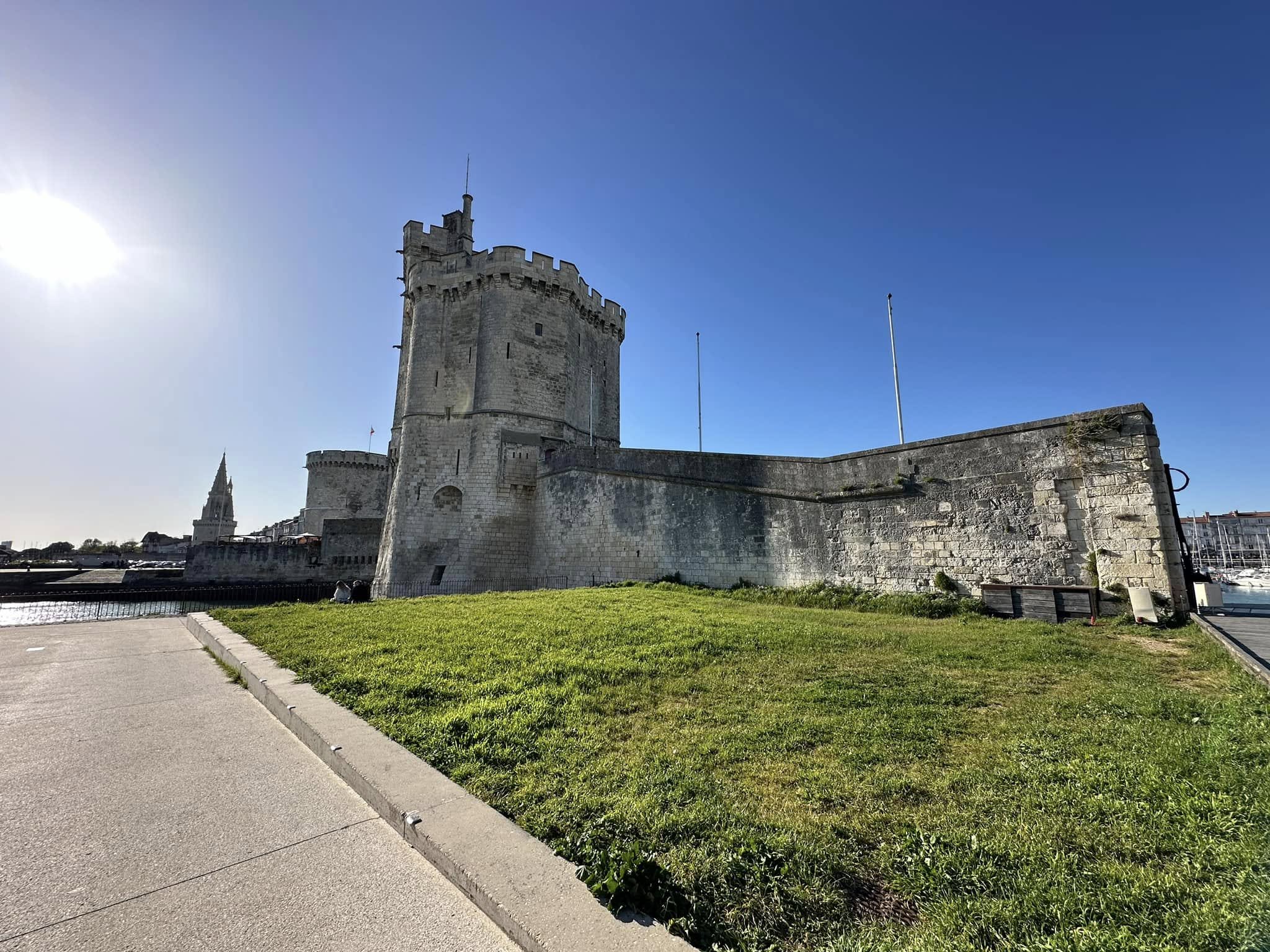
After about a week, barring any issues, they would have arrived in La Rochelle where they would have camped in the grassy area alongside the quay until the ship was ready to depart.

Their fate lay across the water, at the mercy of the sailors, the wind, and of course, God. Did they have second thoughts here?
They probably didn’t know how many people left these shores, but never saw the other side.
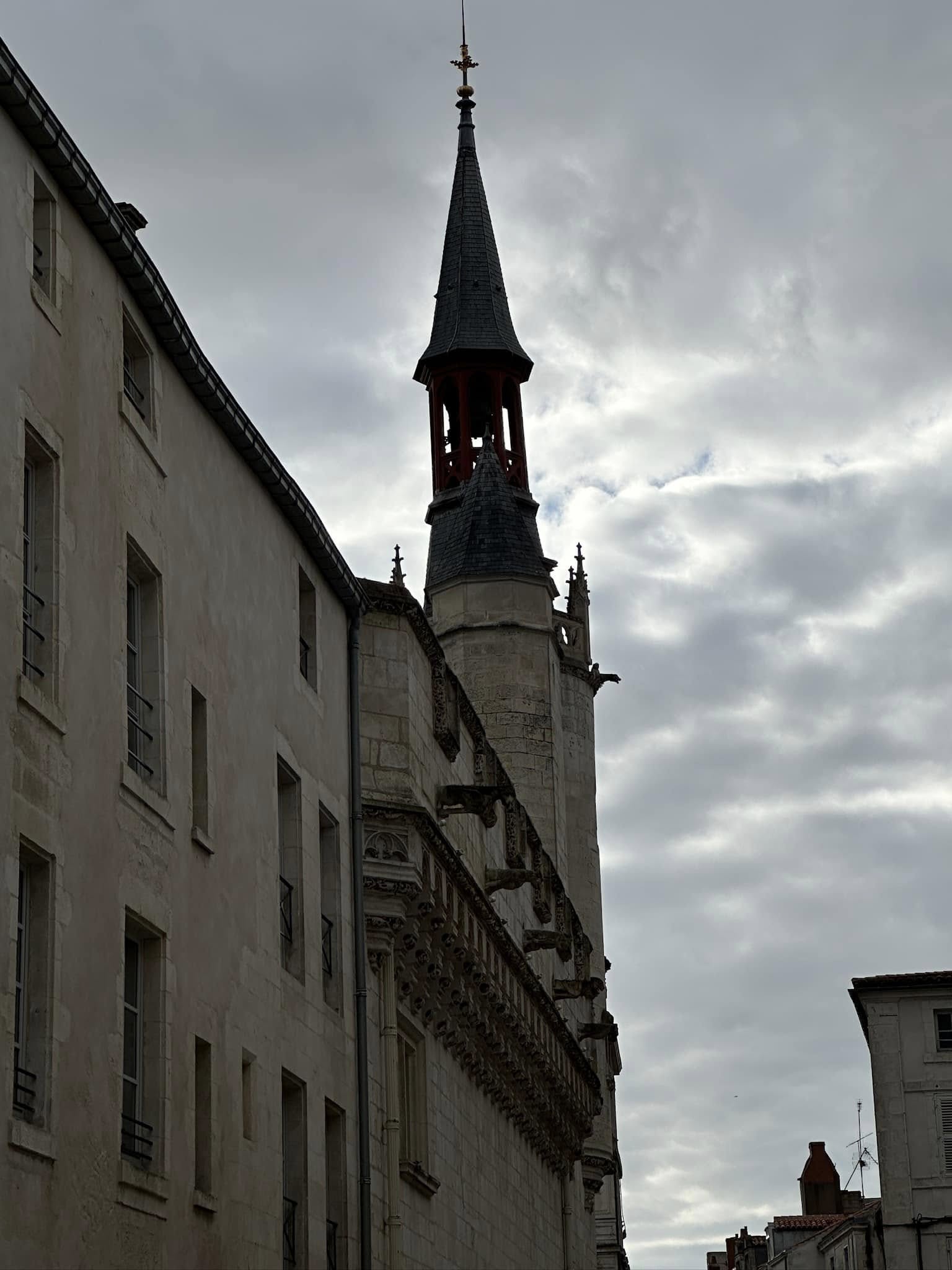
Before boarding the ship and sailing through the harbor gates, they would have attended church one last time. Just in case.
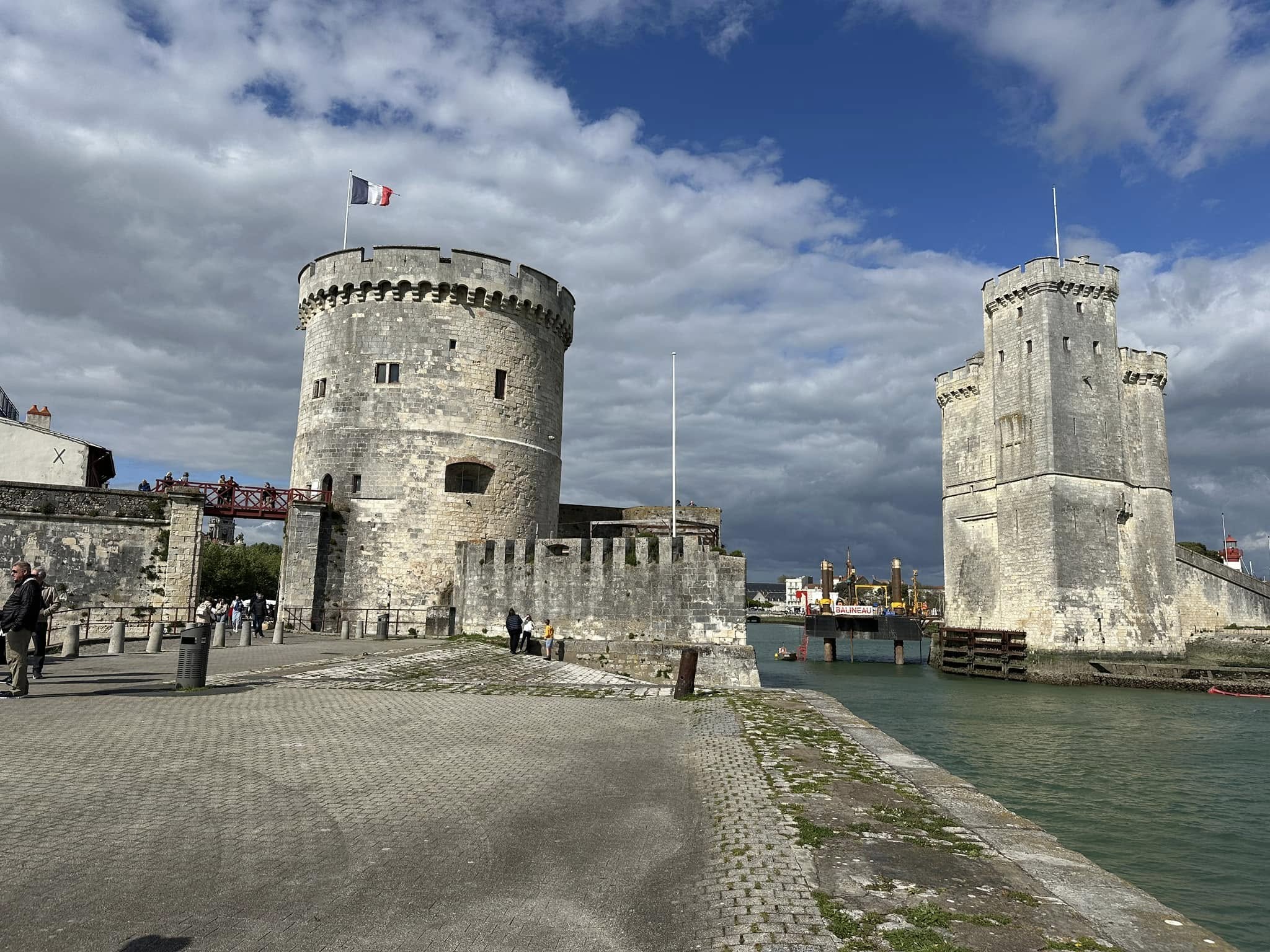
Finally, they boarded the ship and settled into their cramped quarters below. Families were packed into the area between decks. The ceiling was less than five feet, so many could not stand upright. This was a dark, damp, unventilated space that became wet with seawater seepage. They slept on straw pallets, and the lucky ones, in hammocks tied between support beams. And privacy? Guess again.
God help you if you were prone to seasickness.
Their rations for the next six to ten weeks, depending on the winds, and Heaven-forbid, storms, were primarily hardtack biscuits, salted pork, beef or fish, dried peas, and either stagnant, sometimes-wormy water or sour beer stored in wooden casks. Yum!!
They must have felt equal parts excitement and dread, mixed with a smattering of fear.
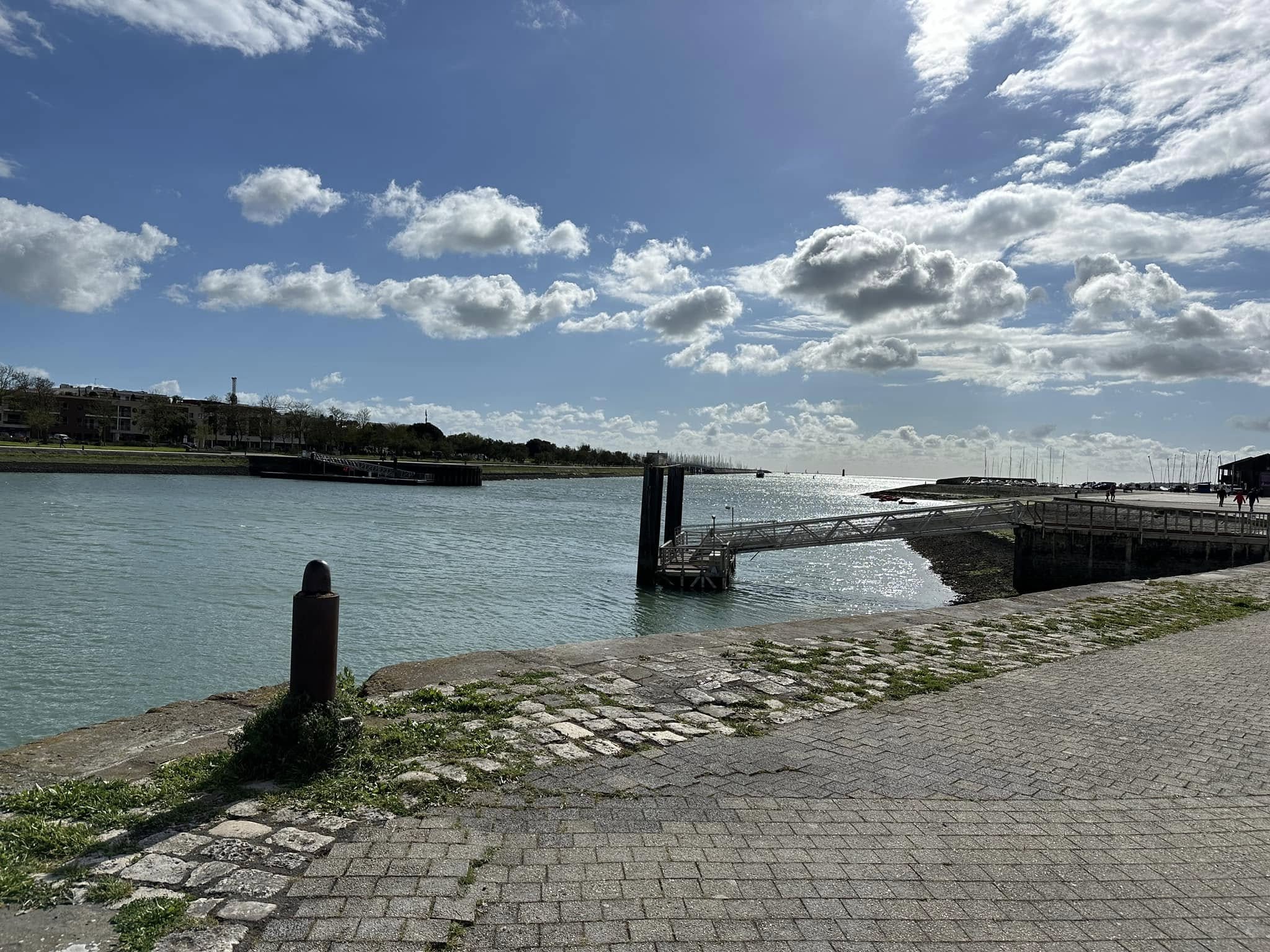
Excitement because their new life that they had heard so much about lay across those waters, outside the safety of the harbor. D’Aulnay had told them of the vast lands and open fields just waiting for them.
Dread because death lay there too.
And fear because so many things could go wrong.

This painting depicts the bustling La Rochelle harbor in 1762, and it probably didn’t look a lot different than it did in the 1640s when Jeanne sailed.
We don’t know exactly when Jeanne left France. We do know that d’Aulnay brought 20 additional families to Port Royal in 1641, and continued to bring families from the La Chaussée area on subsequent trips until his death in 1650.
That said, according to Stephen A. White, a sailor named Jean Poirier arrived in Acadia in 1641 on the ship Le Saint-François.
If this Jean Poirier was the husband of Jeanne Chebrat, she would only have been 14 in 1641. Was this her husband, either then or later? That’s unlikely at 14, but not unheard of. If she met Jean in Acadia – how did she get there? It’s extremely unlikely that she came alone.
Was it the handsome sailor, Jean Poirier, who convinced Jeanne to marry and join him in Acadia permanently? Had Poirier accompanied d’Aulnay back to La Rochelle and La Chaussée after one of their expeditions, perhaps? Did Jeanne marry with dreamy stars in her eyes?
Or, did Jean Poirier stay in Acadia and Jeanne arrived independently somehow?
Was Jean Poirier, the sailor, a completely different person from the Jehan (Jean) Poirier later referenced as the deceased father of Michel Poirier in 1671?
Or, was Jeanne Chebrat never married to Jean Poirier?
What does Stephen A. White have to say?
We have no definitive proof that the same Jeanne Chebrat baptized at La Chaussée in 1627 was in fact the wife of Jean Poirier and Antoine Gougeon. It is nevertheless highly possible that it is the same person, seeing that the Brun family of Acadia originated from the same parish. Furthermore, the Chebrats and Bruns appear to be allied, because the wife of Vincent Brun was a Breau, and Philippe Chebrat, sister of Jeanne, married the widower of a Breau.
I will also add that in Acadia, the Brun family lived just down the river maybe three miles from where Jeanne lived with Antoine Gougeon.
So many unanswered questions.
The 1671 Census
The first actual record we have of Jeanne Chebrat in Acadia is the 1671 census where she is recorded as age 45 and married to Antoine Gougeon. They have a 14-year-old daughter, Huguette Gougeon. They were doing well, with 20 cattle and 17 sheep on 10 arpents of land.
Here’s the unusual thing – Jeanne has no other children living in the household.
This had to be absolutely heartbreaking, because one must assume that Jeanne buried at least 4 children after Huguette’s birth, and probably 5 or 6.
In other households, there are two Poirier young adults listed.
If Jeanne married Jean Poirier around 1641 or 1642, gave birth to Marie Françoise Poirier around 1648 and Michel Poirier around 1650, she had probably lost two or three children before Marie Françoise was born, and possibly another child after Michel.
Her poor mother’s heart.
The Poirier Connection is Strange
Acadian males did not leave home to set up their own household until they married. Yet, in the 1671 census, enumerated one house away from Jeanne Chebrat and Antoine Gougeon, but not next door, we find Michel Poirier, age 20, a laborer, son of the deceased Jehan Poirier, with 2 cattle, no sheep, and no cultivated land. Michel is living alone and is noted as a laborer, which typically means farmer.
This is just so strange. How was Michel supporting himself? Where did he keep his cows? If he was Jeanne’s son, why wasn’t he living with her and pasturing his cows with theirs? If he is living on his father’s land, why wasn’t that now Jeanne’s land? Or was it Jeanne’s land? If so, then why did Michel live in a separate house at age 20?
Michel married quite young, about 1673, to Marie Boudrot, and they settled in Beaubassin.
In 1671, Marie Françoise Poirier, age 22, was married to Roger Kuessy, age 25, and they had one child, a daughter, age 2. They owned cattle and sheep, but had no cultivated land either. They too settled in Beaubassin shortly after the census.
Translated into reality, if these were Jeanne’s children, she probably never saw her daughter again. Women did not seem to come and go, probably due to children and households to run, but males did travel back and forth to trade some, so it’s possible that Jeanne would have seen Michel from time to time. He would have brought news of Marie Françoise and her children.
Maybe Jeanne recalled when she had said goodbye to her own mother at about the same age as her daughter when she left. At least Jeanne’s daughter wasn’t half a world away – so far that one would never even know when their family members passed away.
Widowed, Maybe for the Second Time
Widowed by the 1678 census, Jeanne Chebrat, now called “the widow Gougeon,” has six pairs of horned cattle on 12 arpents of land. Three younger children were living in her household, none of whom were enumerated with her in 1671, and could not have been her children. Two may have been her daughter Huguette’s children with Guillaume Blanchard, who happened to be at her house, or perhaps Jeanne had taken in orphans. Who knows?
Jeanne’s age is not given, but we know that she was 51 years old.
Jeanne’s Death
By the time the 1686 census rolled around, Jeanne was gone, so she died sometime between 1678 and 1686, and between 51 and 59 years of age. Certainly not “old” as we think of aged today.
The Unresolved Question
One question in particular keeps coming back to haunt me.
Why do people think Jeanne was married to Jean Poirier?
The Depositions of Belle-Île-en-Mer
After the 1755 Expulsion of the Acadians, a few Acadians, after a treacherous multi-leg, multi-year ordeal, managed to eventually make their way back to France, as paupers.
On Belle-Isle-en-Mer, depositions were taken in February 1767 to determine the genealogical history of the refugees and their paths to France to determine how much assistance the French government was going to render.
Given that this was 140 years and several generations after Jeanne Chebrat was born, and 112 years after Huguette Gougeon was born, it’s no wonder the refugees’ recollections were incomplete. Not to mention what they had been through.
Stephen A. White published the following information and analysis in 2005 about the descendants of Huguette Gougeon, Jeanne Chebrat’s confirmed daughter. I am grateful for the translation and transcription by Karen Theriot Reader.
Jean Blanchard came from France with his wife, according to Jean LeBlanc, husband of his great-granddaughter Françoise Blanchard (Doc. inéd., Vol. III, p. 43). The deposition of Françoise’s nephews Joseph and Simon-Pierre Trahan is to the same effect (ibid., p. 123). Both depositions mistakenly give Guillaume as the ancestor’s given name. Jean LeBlanc’s makes an additional error regarding the name of Jean Blanchard’s wife, calling her Huguette Poirier. The censuses of 1671 and 1686 meanwhile clearly show that she [Jean Blanchard’s wife] was named Radegonde Lambert (see DGFA-1, pp. 143-144). The source of these errors is probably a simple confusion arising from the fact that Jean LeBlanc’s wife’s grandfather Martin Blanchard had a brother Guillaume who was married to a woman named Huguette, as this writer explained in an article published in 1984 (SHA, Vol. XV, pp. 116-117). This Huguette was not named Poirier, however, but Gougeon, although her mother, Jeanne Chebrat, had married a man named Jean Poirier before she wed Huguette’s father Antoine Gougeon, and all her male-line descendants in Acadia were Poiriers. Unfortunately, we do not know just what questions Jean LeBlanc asked in trying to establish the Blanchard lineage, but he might certainly have had the impression that Huguette was a Poirier from the fact that so many of her relatives were Poiriers, including her grandnephew Joseph, who was also on Belle-Île in 1767 (see Doc. inéd., Vol. III, pp. 13-15).
White explains why he thinks that Huguette Gougeon was mistakenly called Huguette Poirier.
Here’s what Jean LeBlanc had to say.
Statement of Jean LeBlanc:
Jean LeBlanc dit Derico married in June 1726 to Françoise Blanchard, born in St. Charles Parish in May 1705 of Rene Blanchard of Cobequit and Anne Landry of Port Royal; Rene Blanchard issued from Martin and Marie LeBlanc and Martin Blanchard descended from Guillaume, who left France with his wife Huguet Poirier, settled at Port Royal and died there; Anne Landry was issue of Rene Landry, who came from France with Marie Bernard, his wife. Both died at Port Royal.
Of course, we know that Huguette Gougeon, who married Guillaume Blanchard, did not leave France with him, and we also know that Guillaume Blanchard was born in Port Royal about 1650 to Jean Blanchard and his wife, Radegonde Lambert.
This royal mix-up, a double error of blurred memory three and four generations later, is the source of the deduction originally made by Placide Gaudet that Jeanne Chebrat married Jean Poirier – and she may well have.
Is it possible that Huguette Gougeon was actually the child of Jean Poirier?
It is possible, and the census-taker erroneously recorded her as a Gougeon. Census-takers have been known to make mistakes before.
What Evidence Do We Have?
How could we tell if Huguette was a Poirier or a Gougeon?
We don’t have Huguette’s marriage record when she married Guillaume Blanchard about 1673 because the earliest parish records for the church in Port Royal begin in 1702.
However, Huguette’s death entry, recorded in 1717 by the local priest who would have known her, gives her name as Huguette Gougon, not Poirier.
The next unanswered question is whether Jeanne Chebrat was married to Jean Poirier.
Were Huguette Gougeon and Marie Françoise Poirier Half Sisters?
If Huguette Gougeon and Marie Françoise Poirier were not (at least) half sisters, then Jeanne Chebrat was not married to Jean Poirier.
Jeanne Chebrat contributed her mitochondrial DNA to all of her children, but only females pass it on.
Several descendants of her daughter, Huguette Gougeon, have taken mitochondrial DNA tests and are haplogroup HV4a1a4+152. These results represent the mitochondrial DNA of Jeanne Chebrat.
However, according to WikiTree’s known descendants of Marie Françoise Poirier, one granddaughter who carries Marie’s mitochondrial DNA has descendants who are eligible to take that test.
If their mitochondrial DNA results match those of Huguette Gougeon’s descendants, then we have our answer. If they don’t match, then we know Jeanne Chabrat was not the mother of the Poirier children.
Marie Poirier and Roger Kuessy or Caissie had three daughters, two of whom, the eldest and youngest, were apparently both named Marie.
- Marie Caissie, the eldest, was born about 1669, married Toussaint Doucet, and had five known daughters who survived to marry and have children.
- Marie, born about 1692, married Germain Girouard and had 4 daughters. Several of her descendants are eligible to test for her mitochondrial DNA.
- Anne, born about 1697 in Beaubassin, married Denis Gaudet and Jean Bertrand, and died in France. Her daughter’s lines have not been extended to the present, but she may have candidates as well.
- Marguerite, born about 1702, married Paul Doiron, 3 daughters but lines lost after Expulsion
- Madeleine, born about 1714, married Pierre Richard, had two known daughters but no further information is known.
- Marguerite, born about 1717, married Francois Borel, had no known surviving children.
- Madeleine, born about 1688, is found in the 1700 census, but appears to have died between 1703 and 1707. Either that or she married and disappeared.
- Marie, the younger, born about 1697, had only one known surviving daughter, who had no known surviving daughters.
The Miller’s Daughter’s Legacy
Jeanne Chebrat’s life was extraordinary. A peasant French girl whose life stretched from the cold February winds of the Saires plateau across the Atlantic to the tidal coastlines of Nova Scotia and wheatfields of Belle Isle.
Jeanne watched her world divide the day she left the church at La Chaussée, bound for La Rochelle, and again at the quay of La Rochelle, knowing she would never return to her family and the towering windmills of her youth. Sometimes we don’t fully appreciate something until it’s irretrievably in the past.
When she stepped down into the dark tween-decks of a nameless merchant ship, Jeanne also stepped into her role as one of the foundational mothers of Acadia.
I wish we knew more about Jeanne’s life. She survived the notoriously difficult Atlantic passage, and widowhood, probably twice, and helped transform the traditions of the Poitou into the fabric of Acadian life.
Today, her blood flows through thousands of descendants, a living testament to a young woman from La Chaussée who braved the open sea to plant deep, unyielding roots in a new world. She left everything familiar, everything she knew behind with the hope of building something better. Perhaps she carried an adventurer’s soul.
But there’s one mystery left that can be solved.
Are You the Answer to the Final Mystery?
While historical records, maps, and notarial agreements helped us piece together a paper trail, we need genetic genealogy to take us the last mile.
The female-line descendants of Jeanne’s daughter, Huguette Gougeon, have been verified by several testers who have taken the mitochondrial DNA test.
To definitively lock the puzzle pieces together and confirm that indeed, Jeanne Chebrat did marry Jean Poirier, and give birth to Marie Françoise Poirier, we need to test a direct, unbroken female-line descendant of Marie Françoise Poirier.
If you trace your lineage through an unbroken mother-to-mother pathway back to Marie Françoise Poirier, you are a vital keeper of this historical link. If this fits you, and you have already taken a mitochondrial DNA test, please let me know.
If anyone, male or female in the current generation, descends from Marie through all females, I have a free DNA testing scholarship for you. This scholarship covers the entire cost of a mitochondrial DNA test at FamilyTreeDNA for a verified candidate.
If you take the test and match the other testers who descend from Huguette, we will prove that these two Acadian dynasties are actually one, sharing a single, brave mother.
If you qualify or need help reviewing your family tree to find out, please reach out.
Let’s bring Jeanne this last mile home together.
_____________________________________________________________
Share the Love!
You’re always welcome to forward articles or links to friends and share on social media.
Subscribe!
If you haven’t already subscribed, it’s free. You’ll receive an e-mail whenever I publish by clicking the “follow” button at the top of the main blog page, here.
Help Keep This Blog Free
I receive a small commission when you click a vendor link in my articles and purchase that item. This does NOT increase your price but helps me keep the lights on and this informational blog free for everyone. Please click on the affiliate links in the articles or to the vendors below if you are purchasing products or DNA testing.
Thank you so much.
DNA Purchases and Free Uploads
- FamilyTreeDNA – Y-DNA, mitochondrial and autosomal DNA testing
- MyHeritage DNA – Autosomal DNA test
- AncestryDNA – Autosomal DNA test
- AncestryDNA Plus Traits
- 23andMe Ancestry – Autosomal DNA only, no Health
- 23andMe Ancestry Plus Health
Genealogy Products and Services
- MyHeritage Subscription with Free Trial
- Legacy Family Tree Webinars – Genealogy and DNA classes, subscription-based, some free
- Legacy Family Tree Software – Genealogy software for your computer
- OldNews – Old Newspapers with links to save to MyHeritage trees
- MyHeritage Omni comprehensive “everything included” subscription plan
- Newspapers.com – Search newspapers for your ancestors
- NewspaperArchive – Search different newspapers for your ancestors
My Books
- DNA for Native American Genealogy – by Roberta Estes, for those ordering the e-book from anyplace, or paperback within the United States
- DNA for Native American Genealogy – for those ordering the paperback outside the US
- The Complete Guide to FamilyTreeDNA – Y-DNA, Mitochondrial, Autosomal and X-DNA – for those ordering the e-book from anyplace, or paperback within the United States
- The Complete Guide to FamilyTreeDNA – Y-DNA, Mitochondrial, Autosomal and X-DNA for those ordering the paperback from outside the US
Genealogy Books
- Genealogical.com – Lots of wonderful genealogy research books
- American Ancestors – Wonderful selection of genealogy books
Genealogy Research
- Legacy Tree Genealogists – Professional genealogy research