
I wasn’t going to write anything for Mother’s Day this year, because Mother’s Day is bittersweet for so many of us. Such powerful and sometimes overwhelming emotions braided together – love, longing, gratitude, and loss. But then, while changing the sheets, I opened the chifforobe and saw her quilts.
I reached out and touched them, closed my eyes for just a second, and saw a scene from long ago.
I began quilting with Mom and the “church ladies” in the church basement, years before I was even old enough to drive. We sat around the frame together, making quilts for the missionaries to take to Africa. It never occurred to me that in Africa, probably the last thing anyone needed was a quilt.
Nevertheless, we believed we were doing something altruistic, useful, and charitable together.

Sewing, in the high school yearbook.
When I learned to sew, I really enjoyed it and began to use the scraps from the clothes I made for both me and Mom to make quilts.
I stopped making quilts after I married, and children arrived. I simply didn’t have time for everything. In addition to taking care of my family, I worked and was slogging my way through college.

For a long time, the best I could do were quilts for family. This quilt for my daughter was one of the first quilts I made when I began quilting again.

Plus, one for her dolls, of course.
Occasionally, I’d make a quilt for a family or someone in need due to a catastrophe of some sort, but my time was still quite constrained.
Because I already had no time, I became a volunteer for the local Humane Society, working with injured fur-persons as a foster-Mom. Not only did it help the animals in need, but I felt it would be a wonderful way to teach my children important values.
The Humane Society was having a fundraiser auction, and I thought it would be a great idea to make a quilt.

Not only did I make that quilt, but I also bid on it and won my own quilt. One of my children liked it so much and had been incredibly disappointed when I told them it was a donation quilt. It would have been much less expensive to make a second quilt, but that child had fallen in love with “that one”!
My time was still limited, but next on the list of quilt recipients was Mom. Over the years, I made Mom a few quilts, and I’m so glad that I did.
The Handbell Sampler Quilt
I visited a local quilt shop where I signed up for a sampler class in which we learned useful techniques while making a variety of blocks.
Mom mentioned how much she liked the colors and individual blocks, so I decided it should be her quilt.

This Sampler Quilt was the first quilt I made for Mom and it included a handbell design that I drew and quilted in each corner. Mom played in the handbell choir at church.
This is also the only full-size quilt I ever entirely hand quilted. Hand quilting alone was very different than quilting as part of a group, with camaraderie and many hands, which meant the quilt was finished relatively quickly. I discovered that I loved the design part and piecing the colorful tops, but not the actual quilting itself.

I was excited to give this quilt to Mom for Christmas. Unfortunately, this is a horrible picture, but it’s the only one of Mom with the quilt. I’m at left, Mom is in the middle and my daughter stands on the right. Some of the fabrics from my daughter’s quilt are in Mom’s quilt, because that’s how quilts work. Love, shared and passed on.
Ironically, I found a leftover scrap of the corner fabric with the bells just last week. Now, that fabric will go into a quilt and become part of extending our three-generation legacy of love.
If there’s a lesson to be learned from this, it’s take lots of pictures. With cell phones, that’s not an issue today – and neither is waiting to get them developed and printed, only to discover too late that the photo is awful.
Mom loved this quilt so much that she hung it over a quilt rack where she could see it, but it was always being saved “for good.” I can still see it in my mind, standing in a place of honor in the corner of her bedroom. To this day, I have no idea when quilts saved “for good” were to be used, but it seems the answer is that they are much loved, but not a part of daily life.

Know where that quilt lives today? In that chifforobe, folded neatly on a shelf. Never used, never gotten dirty, never washed – loved, but never sharing in life. That wasn’t what I had in mind, especially since I had designed the block with the bells just for her. But she loved it, and that’s really all that mattered.
Ironically, now I don’t want to use it because it was Mom’s, it’s hand-quilted, and I don’t want to ruin it somehow.
I commit right now to putting it on the bed in the guest room!!

The time to use the “Good Quilt” has finally come, and it will be waiting for my daughter next time she visits.
The Scrap Kaleidoscope Spiderweb Quilt

Several years later, I made Mom a scrap spiderweb quilt, also called a kaleidoscope quilt. I figured she would actually use this one – as in sleep under it on her bed. I made it using scraps from the other quilts I had been making. There were scraps from her sampler quilt, my daughter’s quilt, quilts I made for Dad before he passed, quilts for other family members, care quilts, and so many more. Just looking at this quilt is a trip down memory lane.

We even used this quilt as a backdrop for family photos.
Mom slept under this quilt from the Mother’s Day she received it until she passed, five years or so later.
In her final days, when Mom was in the hospital, I slept in her bed at her apartment, and this quilt comforted me too. Now, sometimes I use this quilt on my bed, or put it over the back of the couch and smile as I walk past.
Stars Over Broadway

The third quilt I made Mom was actually a wall hanging meant to honor her. Mom was a professional tap and ballet dancer in her younger years. By the time I arrived, she had retired as a dancer, was working in an office, and had taken up crocheting as a hobby.
Mom created stunningly beautiful crocheted items, like tops, vests, coats, purses, and, of course, traditional afghans.

Her pièces de résistance, though, were lacy items – shawls, like the one above, tops and even a bedspread.
Each female in the family, and others she loved, received a beautiful shawl meant for dressy affairs. When she passed, this shawl was left and went to her great-niece, which would have pleased Mom immensely.
Mom entered her creations into fairs and other competitions, often bringing home blue ribbons and Best of Show rosettes. First locally, then across the country.
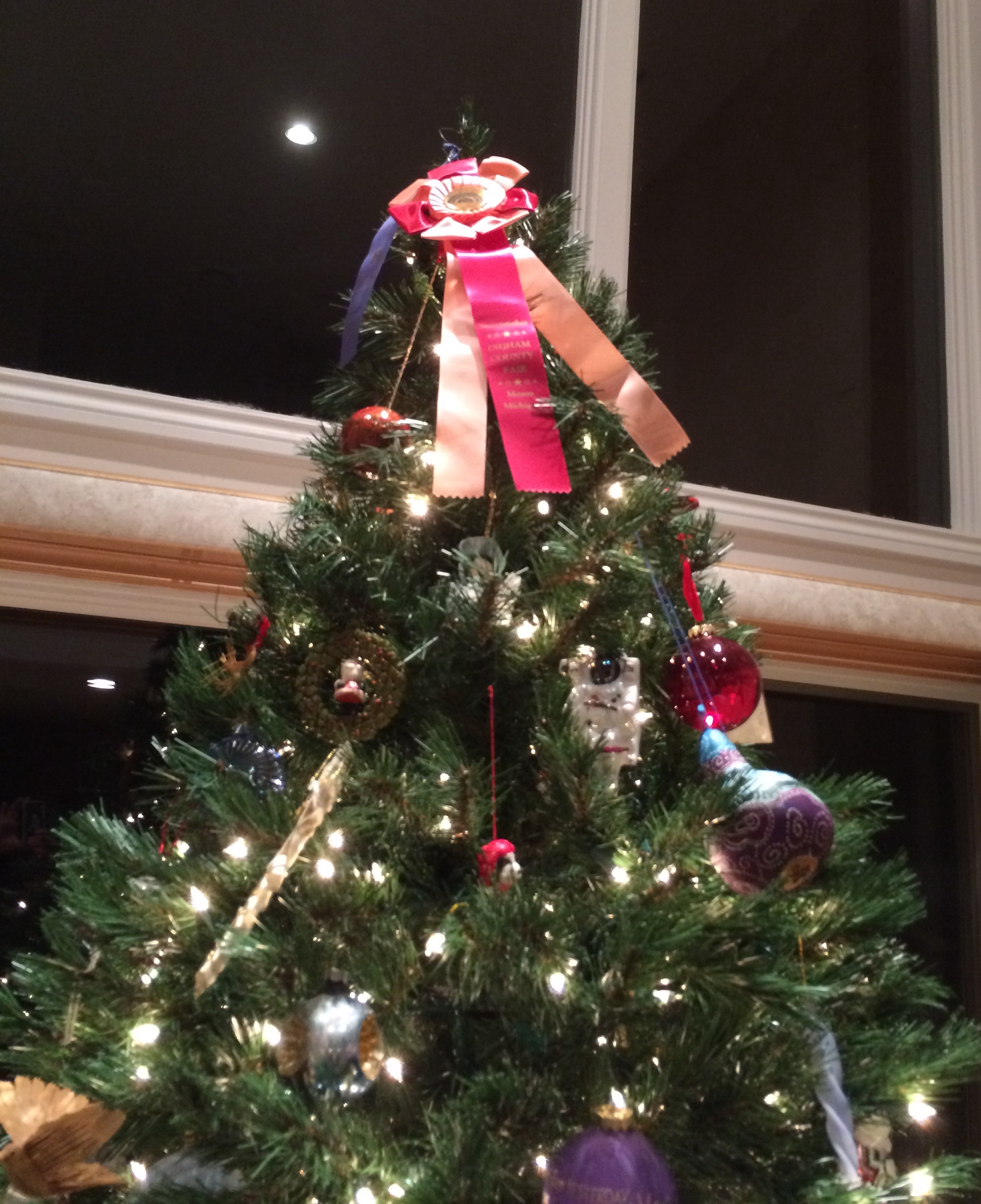
I even adapted one of her Best of Show rosettes as a Christmas tree topper.
We began taking our things to competitions together. Me – cross stitch, counted thread and quilts – and Mom – all manner of crocheting. Often, my daughter joined us. She won her first National award when she was about 11 for an original art piece. We were so proud of her!
As much as was possible in that day and time, Mom’s life had been rooted in creativity. When she retired from dancing, her creative outlet took other forms.
I never realized it then, but by example while I was growing up, Mom had been fostering that same creative spirit in me as we worked on varied crafts together.
When patterns were too expensive or not exactly what we wanted, we made our own and utilized every scrap of everything.
Our kitchen table was often a creative mess, with an old sewing machine, supplies, scissors and other materials scattered all over, but did we ever have fun!!

So, the third quilt I made Mom was titled “Stars Over Broadway,” a nod to both fields in which she excelled. I utilized just a few of the ribbons she had won over many years, plus one of mine and my daughter’s too. The three of us together.
By this time in my life, I was designing and making art quilts, so the style had changed a lot, and I was no longer using patterns.
There’s a lot of symbolism in this quilt. The ribbons dance in a circle, holding hands – echoing the bond between the women in our family over generations. Light to dark reflects the passage of time. My daughter is the “Seventh Generation of Hoosier Needlewomen” in our family, the name of an exhibit the three of us hung together at the Allen County Public Library a few years earlier.
This quilt is also affectionately nicknamed, “Never Again,” because I discovered that there is absolutely no “give” or flexibility in those ribbons so the cutting and sewing had to be absolutely precise! Hence, never again!

At a 1988 awards banquet in Louisville, KY, Mom wears a beautiful, crocheted top that she created.
Mom would often accompany me to shows and venues where my work was being exhibited, along with awards banquets. She amused me. Never mind my academic degrees and profession – it was my artistic endeavors she was the proudest of. Perhaps because she could see, feel, and understand those.
But it was the fourth quilt, the fourth quilt that I made Mom that was different.
Before I share that quilt with you, I need to explain something about quilts.
What is a Quilt?
This isn’t a technical answer – but an answer from my heart.
A quilt is whatever you need it to be in the moment. Quilts are created and given for a multitude of reasons – but how they are used, when, and for what purpose, is entirely up to the recipient. Quilts have a life journey and purpose of their own. Sometimes the same quilt is different things at different times, and even to different people.

A quilt can serve as an art piece, or a room decoration, something to sleep under, or a picnic quilt.

Quilts are their own language of love, given as an expression of love, caring, and hope. Every minute we work on a quilt, every stitch is made while lifting the recipient into the light. Prayer quilts, care quilts, comfort quilts – a quilt by any name you wish to call it.
Sometimes we make memory quilts. Using Mom’s clothes, I made memory quilts for all her children and grandchildren. They selected the clothing that they wanted in their quilt. This was difficult for me, but it was also a way that I could say farewell, at least on this plane, and process my grief.
Plus, I got to relive such wonderful memories and give each of them one final gift from her.

This is my quilt. There are enough stories here to last for days, many funny or heartwarming. Some of these squares are from sweatshirts that I cross-stitched for her, and the blue stripe in the left-hand bottom corner is the tie that my Dad (step-father) wore when he walked me down the aisle.
Mom always bought linen calendar towels for each family member for Christmas every year – no matter how much we hinted that we already had enough. None of us liked them, but after she was gone, we cherished them because they were uniquely from her. Now they are all in our individual quilts – with years selected to mean something to the recipient – and of course the associated stories that those memories evoke. I laugh every time I see mine! I also get teary-eyed.
I’ll be getting this out on Mother’s Day, along with a box of Kleenex.

My daughter’s quilt. Everything here is symbolic, including the rose fabric. Mom loved roses. A college t-shirt that my daughter bought my mother as a gift, a piece of Mom’s blue bathrobe that she wore for years, along with part of the cute pig towel from the kitchen on the farm where Mom and Dad raised hogs.
Memory quilts aren’t meant to be beautiful. They are meant to be meaningful and comforting, even joyful.
Quilt makers want their quilts to be used in whatever way the recipient needs.
Larger quilts typically serve as traditional bedcoverings. If someone doesn’t feel well, a quilt comforts. Smaller, personal size quilts are often more easily portable. I have at least one in the car at all times.
If you’re cold, grab a quilt. It will keep you warm.
If you’re sleepy and need a nap, grab your quilt. It will refresh you.
If you feel ill, grab your quilt. It will help heal you.
If you need a hug from one or maybe all of your ancestors, by all means, grab your quilt. Let them hug you. It will comfort and encourage you.
If you need a hug from someone who is not there, wrap your quilt around yourself in a big hug.
Mom’s Quilt
The fourth and final quilt that I made Mom is simply called Mom’s Quilt.
I went to a class in Northern Michigan with a friend to learn some new quilting techniques. We were excited because, among other things, it was a girls’ road trip.
In that class, with the aurora borealis dancing overhead at night, I made a smaller, personal-size quilt. I didn’t know how it would turn out, so I wasn’t making it specifically “for” anyone, but it just happened to be in some of Mom’s favorite colors, and made from some of the fabrics I had used in other family quilts.
After Dad passed away in 1994, Mom moved to town. She never really recovered from his death and slowly declined over the following decade. As she aged, she was always cold, and I didn’t want to encourage her to bring her bed quilt into the living room to use in her recliner. I was afraid her feet would become tangled, and she would fall.
I finished that aurora borealis quilt for Mom, feeling as if it had been specially blessed by Dad, watching over us from the Heavens. We could even hear the aurora those two nights, crackling and popping in the glorious sky as we looked up. I was spellbound, wide-eyed and speechless. I had never seen the aurora borealis before and felt like a child who thinks they unexpectedly caught a glimpse of Santa. I wish it hadn’t been before the days of photos on cell phones. When I finally fell back to sleep, I experienced extremely vivid dreams that included Dad and lingered long after morning.
Mom loved that quilt. She fell asleep in her chair, drawing it close and snuggling under it daily, with her cat firmly planted on her lap. Now I desperately wish I had taken a picture of her with her quilt in her chair. That’s how I remember her often.
Why do we only think to take pictures on “special occasions” and not of normal, everyday life?
When I gave Mom the quilt, it was “just a quilt,” until I realized she used it every single day. As her health deteriorated, and after she fell and broke her pelvis, she used it even more. It was no longer “just a quilt.” It had a much more important job.
I managed to extract it from her long enough to wash it once or twice, but for the most part, it was glued to her during her last few years. Although she eventually recovered enough to go about her life, delivering Avon to her friends and customers, she and that quilt were inseparable when she was home. It was like a favorite bathrobe or pair of comfy jeans. It became burned into my memory – Mom sitting in her chair, wrapped up in her quilt.
Mom’s quilt.
Mom passed on April 30, 2006 and it was on Mother’s Day that year that I had the utterly miserable task of packing up everything in her apartment and loading it into a U-Haul to bring it all home. That was the saddest Mother’s Day of my life.
On the morning of her stroke, Mom’s quilt rested in her chair from the evening before when she used it for the final time. I could tell she had fallen asleep there and had simply gotten up and gone to bed. It was still shaped like her body, with her crossword puzzle book and pencil lying with it.
I took her quilt to her in the hospital where she initially touched it, clutching the edge with her one good hand, but her condition worsened, and she was no longer even slightly conscious. After hospice entered the picture, and her care became “messier,” the staff said we should take the quilt home so it didn’t get lost, stolen or thrown away. We could always bring it back if she recovered consciousness, but we knew that wasn’t going to happen.
I took the quilt back to Mom’s apartment where my daughter and I were staying to be close to the hospital, just two blocks away. I returned it to her chair, even knowing that she would never sit there again. That’s where it seemed to belong, holding space.
That Mother’s Day, I gently folded it up, put it on the seat beside me after everything was loaded, and brought it home.
I probably should have washed it, but I just couldn’t. The places that showed a bit of wear that might have needed a bath were “her,” and I wanted all of her I could preserve.
I put Mom’s Quilt away. Every time I saw it, I saw her, jolting me back to the reality that she was gone. I just wasn’t ready for that yet. Losing Mom was losing my last anchor, and I felt adrift, unmoored in an ugly and painful sea.
Grief is love with nowhere to go – but after some of the initial shock and pain subsided, I had such fond memories of our time together, and I began to smile again.
It didn’t take too long for me to get the quilt back out, because it reminded me of her.
Mom’s quilt migrated around the house, sometimes on the back of the loveseat, sometimes on the back of “her chair,” which I brought home and put in my bedroom, sometimes on the quilt rack where I could see it, and from time-to-time, in my office.
When I saw Mom’s Quilt, I would smile. Sometimes there were still tears, but less often.
You never stop needing your mom.
Life happened.
Over time, other tragedies occurred, ushering in overwhelming, crushing loss. I needed to feel close to Mom, so I retrieved her quilt from wherever it was living at the moment and wrapped myself in it. I always felt better knowing it had brought her comfort too.
Life brought celebrations too.
The Labyrinth

About 25 years ago, I designed and installed a labyrinth in my yard as a place of quiet reflection and introspection, a spiritual walk designed to allow us as travelers upon the earth to move a few steps closer to the Creator.

On one especially momentous day, I wanted to feel close to Mom, to share joy with her, so I draped her quilt around my shoulders and walked to the labyrinth.
Mom and I walked together, wrapped in love.
Hope buoyed us.

Well, actually, we sort of flew, with the wind beneath our wings.
Jim slipped quietly out behind me and took pictures. Thank goodness he did.

The labyrinth is designed for the journey seeker to arrive in the center after a freeing, contemplative walk all the way around each of the labyrinth’s intersecting circles. The labyrinth itself is representative of the “Center,” a place of quiet contemplation. A place to free one’s mind and reflect.
A labyrinth is the polar opposite of a maze which is filled with dead ends and frustration.
In a labyrinth, there is only one path, with no distracting decisions to make, and the walker arrives effortlessly in the center.

For the center of my labyrinth, I selected a stone shaped like a “seat” to facilitate reflection while overlooking a field, pond and woods. Nature at its finest. Quietly healing and nurturing.
Sometimes, though, we turn and look backward, reflecting, before looking ahead again.
Life was changing. The tide was turning.
I am no longer the steward of the labyrinth, and life has changed dramatically in the past few years, but when I need or want to feel close to Mom, I still reach for her quilt. It’s timeless.
One day, my daughter will do the same.