
Every now and again, Fate just smiles on us genealogists. This time, Fate enlisted the help of my wonderful Campbell cousins.
One of my cousins purchased the contents of an abandoned storage unit at auction, sight unseen. He was hoping for the best, and could have chosen to sell the Bible, photos, and tintypes that he discovered buried in the contents. But he didn’t!
Instead, he asked his son, an avid genealogist who just happens to be restoring their ancestral Campbell home, if he had any idea “who these people are.”
His son took a look, found the center pages with lists of births, marriages and deaths, and thought he remembered an article about the McDowell line. A quick Google search turned up my article and confirmed his memory. McDowell was there, along with some of the other names in the Bible’s pages.
So, here’s kind of how this message string went:
Campbell cousin: Roberta, John McDowell is listed in this Bible as well as his daughter Matilda. I think it could be Matilda and her husband’s family Bible. Are you interested?
Me: OMG! OMG! I absolutely want that Bible. These people, at least some of them, are buried in the old McDowell Cemetery on Slanting Misery.
You’re shocked, right?

Next, he took photos with his phone and sent them along.
I recognized some of the names and knew this was the right family, but I couldn’t tell much more.
His father was kind enough to send me the Bible. Needless to say, I was thrilled beyond words. Thanks to their kindness, we can save this Bible and its contents from the dustbin of history.
The Bible Arrives

This box was larger than I expected and VERY heavy. I wondered what else was in there – like rocks maybe.

This Bible is HUGE.

I was going to hold the Bible up so you could see it, but it’s in very poor condition, with the spine falling apart, and I didn’t want to do more damage.

I handled it very carefully, removing it from the box with the help of a towel and supporting it because the spine could no longer do so.
These large, showy Victorian Bibles with color plates and maps weren’t carried back and forth to church. They served as centerpieces in homes and, thankfully, were used to record important family dates.
Some of the front pages appear to be missing because I couldn’t find the publication page among the loose pages tucked in the front. However, I did find dates on maps and on some pages that said 1885, so I know this Bible was either published in 1885 or later.
This means that the earliest entries in the Bible had probably been copied from an earlier Bible.
Who’s In the Bible?
I took close-up photos of the pages that included names. I also discovered a page from a tablet, tucked into the Bible, on which someone had been calculating ages.
I hoped that information from these pages would allow me to create a family tree.
Whose Bible was this, and what was its path in life? Where has it been for the past 140 years?
I’m going to transcribe each page before attempting to assemble them into a family. It proved to be more difficult than I expected.
My notes regarding names are in parentheses.

The first birth recorded was that of the patriarch of this branch of the family. The latest birth date was in 1922, but the list ended with an earlier birth, recorded more than 31 years after it occurred. That was strange.
- John Mc Dowell was born March the 22nd 1783
- Surena (Serena) Mc Dowell was born March the 11th 1826 & Decd Nov 7th 1893
- Matild (Matilda) Mc Dowell was born Nov the 19th 1829 & Decd Feb the 5 1888
- Caroline Mc Dowell was born Jan the 16th 1830 & Decd Oct 4 1899
- Rufus M Tipton was born Aug the 29 1840 & Decd July 3rd 1897
- James Speer was born Nov 26th 1846
- Elnora Speer was born June the 16th 1873
- William E Breeding was born Decr 10th 1870
- Darcy (Dorsie, Dorothy) Breeding was born Decr 10th, 1889
- Edward William Riley was born Feb 8 1922
- Lina (or maybe something else like Lucie?) V (or N?) Breeding was Born Sep 22 1891
As I reassembled the puzzle pieces of this family, I absolutely could NOT place that last out-of-order entry for Lina or whatever their name was, but it would turn out to be the key to who owned this Bible, and more.

- James E Speer and Matilda McDowell was Married Nov the 6th 1870
- Rufus Tipton and Caroline McDowell was Married Oct 23th 1879
- Wm E Breeding and Elnora Speer was Married Jan the 13th 1889
- W S Riley & Dorsie (Dorothy) Breeding was married Oct [No year provided]
- W E Breeding & Lillie Vancel was married Aug 12, 1937
The last marriage was entered in 1937. That too is a clue.

- John Mc Dowell Sen (Senior) Decd Oct 17th 1877
- J. E. Speer Die Jan 13, 1923
- Mollie Speer Died June 27 1914
- Hettie Grear Died 1918
- Elnora Breeding Dide January 23, 1937 8.30 am
The last death was also recorded in 1937. Is this a clue too? Why did important family events stop being recorded in the Bible?

This piece of paper was tucked between the Bible pages. Its entries are from 1910. Why weren’t these deaths recorded on the death page of the Bible, in order, with the others?
- Patterson Breeding Dide Feb 1. 1910 Age 84 y 4 m 20 d
- Tip Chadwell Died Feb 8 1910 Age 15 y old
- Rittie Chadwell Died Feb 12 1910 Age 38 y old
This handwriting leaves a LOT to be desired, and there’s the word died spelled “Dide” again, but the same person apparently did know how to spell it because the following two entries are spelled correctly.
On the back of this paper were a few more names and some date calculations.

- W E Breeding & Elnore Speer was married Jan 13, 1889
- Elnor Speer was Born June 16, 1873
The math at the top shows someone calculating Elnora’s current age (61) and how many years she had been married (45). Those calculations, based on her birth and marriage dates, would have happened in 1834.
Connecting the Dots
Where does one begin to piece this together?
The most obvious place was with the oldest person or entry, which was John McDowell, the son of Michael McDowell, my ancestor. Michael was born in Wilkes County, NC, and moved to what was then Claiborne County, TN, in 1809 or 1810, establishing his family on the next frontier.

Michael was granted land in 1814 that earned its name, Slanting Misery, which is today located in Hancock County, TN, on the border with Lee County, VA. Michael lived here for the rest of his life.

If you’re wondering how Slanting Misery got its name, this photo explains everything! Imagine trying to farm this land.

Standing on Michael’s land, on the highest point of that hill, I took photos before panoramas were a thing and reassembled the surrounding mountains, mostly on the other side of the S-shaped Powell River.

Michael’s son, John McDowell, was granted land adjacent to his father’s original patent. In time, the McDowell family owned all of the Slanting Misery peninsula. A land dispute in 1861, 21 years after Michael died, helped me piece together his family.

In the 1980s, I made my first journey to Slanting Misery. To get there, we had to ford the Powell River.

By ford, I mean wade.

These folks, who made that trip in the 1970s were smarter about the process than I was.
I couldn’t find the cemetery during the first visit. Let’s just say that Slanting Misery is expansive – a mountain on a peninsula of land surrounded by river, and you can’t even begin to see all of it. I had a description of where the cemetery was located, or had been when these people visited, but the landmarks they provided were unrecognizable by the time I made the trek.
When I returned a few years later to try again, with a local man to help, we forded the river in my Jeep. I don’t know if I was brave or stupid. We were chased back to the Jeep by an angry bull, but thankfully not until after we found the remnant of the cemetery. Remnant being the operative word.
In the aerial photos, you can see a small trail that turns to the right after you reach land.

You can see the trail here too. The location of the cemetery is beneath the tree. The barn and watering hole for cattle along with the the original house and well are nearby.

Following Michael’s death on July 6th of 1840, he was buried in the cemetery on his land. Over time, this came to be known as the McDowell Cemetery, of course. He was the first of many family members to be buried here.
When I finally found the cemetery, it was in bad shape with almost no visible stones.

A few years earlier, in the 1970s, it had been in much better condition. Unfortunately, the cemetery was not fenced, and cattle are extremely difficult on tombstones, knocking them over and breaking them. Even in the 70s, many were unreadable.

At that time, the old well and house foundation that were supposed to be my landmarks were still visible.

However, the swinging rope bridge that spanned the Powell River at this little island, connecting the McDowell land to the road leading to civilization, had been swept away in a flood years before, so now all visitors had to ford the river one way or another. One might say that Slanting Misery was extremely remote.
It was here, on Slanting Misery, that the McDowell Bible spent its life until around 1930 when Elnora Speer and Ed Breeding moved to town, and of course, the Bible went with them.
For those who might want to research this land further, Hancock County deeds are not online in any of the normal places that genealogists look, but the indexes are.
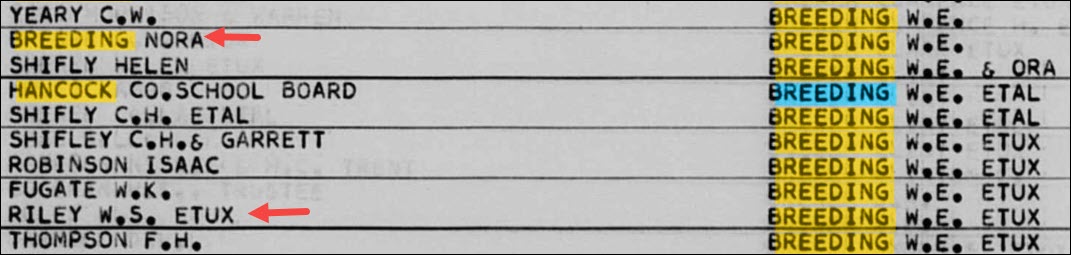
There are 10 deeds from W. E. Breeding and W. E. Breeding et ux (and wife) and et al (and others) in the Hancock County Deed Index. For anyone trying to untangle the land ownership, I’d recommend calling the Hancock County, TN Register of Deeds or using their linked paid search service.
Relevant to the Bible entries, there are also two deeds from James E. Speer and wife to W. E. Breeding and wife.
William Edward (known as Edd) Breeding’s wife, Elnora Speer Breeding, died in 1937, but she is not buried in the McDowell Cemetery. Edd Breeding is the last known family member to own the land, but the deed to William S. Riley and his wife, Elnora and Edd Breeding’s daughter, may suggest otherwise. It doesn’t appear that the Rileys ever lived on Slanting Misery.
So how are all these people connected?
Reassembling the Family
John McDowell was the first person recorded in the Bible.

This photo is identified as John P. McDowell, but there’s no evidence that this John McDowell had a middle name. A later man was named John P. McDowell. This image is not from the Bible, but has been passed around for decades and was submitted by a family member for inclusion in a 1994 book.
Based on what we know now, this was probably originally a tintype image taken not long before John’s death in 1877.
What can we tell about this photo, and which John McDowell was it really?
Given that John died in 1877, and there are other known photos and tintypes of this family about the same time, let’s begin our analysis by presuming this photo or tintype was taken in the 1870s. The man in this photo is not young, and the photo has been retouched or restored, perhaps when being copied, long before AI.
This man’s clothing dates from an earlier era, from the 1840s or 1850s. His unique and recognizable rigid stock tie dates from that time. Younger men would have been wearing more contemporary string ties or neckbows, which were much less formal. Assuming this is John, he’s dressed in his best just a few years before his death and was clean-shaven, a sign of dignity and manners when he grew up.
The Bible showed John’s birth in 1783 and his death in 1877, with exact months and days, so it was probably not entered from memory more than a century later.

John is buried in the McDowell cemetery, although not much is left of his stone. His name was barely legible when I visited. I wish I had taken better photos.
John died at least eight years before this Bible was printed, so this was not his Bible. This suggests to me that this information was either copied by the Bible’s owner from another Bible, or maybe confirmed from a tombstone.
In 1817, John McDowell purchased Slanting Misery from his father. By this time, John was already 34 years old and had probably already married Nancy Busick, although she is not recorded in the Bible, an omission I found odd. She died in 1841.
Beginning in 1825, John obtained multiple parcels of adjoining land.
Based on early census records, John and Nancy had children who did not survive, but the Bible only records John’s three daughters who survived to adulthood. It also does not record any of John McDowell’s siblings, one of whom, Mary, lived in adjoining Harrell Bend, just across the river.
I had already pieced this family together somewhat based on the tombstones that remained when I visited, a cemetery survey taken in 1994, genealogy research, and a 1997 letter from Opal, a lovely lady in her 80s.
From this combined information, I was able to determine that:
- John’s daughter, Caroline McDowell, married Rufus Tipton, whose birth and death are recorded in the Bible. They were married in 1879 when Caroline was already 49 years old, so they did not have children. I researched Rufus, who served in the Civil War, was hospitalized either three or four times, wounded, and still managed to return home. In the 1880 census, the McDowell sisters are all living in the James Speer household, so I would interpret this to mean that both Rufus and Caroline, who died two years after Rufus, are buried in the McDowell Cemetery.
- John’s daughter, Surena McDowell, never married. She died in 1893 and is buried in the McDowell Cemetery as well.
- The third daughter, Matilda McDowell, married James Edward Speer in 1870 when she was 40 years old. James was born in 1846, so he was 17 years younger than Matilda. I’m sure that was somewhat of a scandal.
Some records list Speer as Speers, and others spell it Spear or Spears.

John McDowell’s two sons, Hill and John Jr., and their families aren’t recorded in the Bible either, so we know the Bible did not belong to them. Only John’s three daughters who remained on the old home place are included in the Bible, and only one daughter, Matilda, had children.
Matilda married James Edward Speer.

In this photo, James Edward Speer looks to be about 30-35 years old. This is not from the Bible and was probably a tintype.
His neatly parted hair, long mustache, and chin beard suggest the 1870s, as does his high-buttoned vest, which leaves a little of his white shirt showing.
His hand is holding his jacket, a typical pose in portraits of this era. Not only was it stylish, but it also helped him remain motionless during the camera’s long exposure time.
Given James Speer’s birth in 1846, if he were 30-35 in this photo, it would have been taken between 1876 and 1881.

James and Matilda only had one known child, Elenora (Elenore, Nora) Speer, who was born in June of 1873 and whose birth is recorded in the Bible. If they had a child before Elenora, the child wasn’t recorded in the census, the Bible, or the cemetery – although infants probably only had fieldstones marking their graves.
So far, all of these births occurred before the publication date of the Bible, which was no earlier than 1885.
Matilda McDowell died on February 5, 1888, when she was 58 years old, and her daughter, Elenora Speer, married William Edward Breeding 11 months later on January 13, 1889. She would turn 16 that June.
Matilda is buried in the McDowell Cemetery.
Given that Matilda died in 1888, just three years after this version of the Bible was first printed, it may not have been Matilda that maintained the Bible pages. Regardless, after 1888, her daughter, Elenora did. There’s a gap and a noticeable handwriting change on all of the pages after 1889.
After Matilda died, James Edward Speer remarried to Mollie Thompson sometime before September of 1891 given that their first child was born in June of 1892. She is the Mollie Speer that died in 1914. Neither Mollie’s birth nor their marriage was recorded in the Bible. Mollie was born in 1864, so she was 18 years younger than James Edward, and 35 years younger than Matilda. This clearly did not go over well within the McDowell family.
Elenora’s stepmother was only nine years older than she was. Mary Opal Greer Herrell’s letter revealed that Elenora, Nora as Mary Opal called her, never accepted her stepmother and was “raised by the McDowell women.”
James Edward Speer and Mollie Thompson had two children, Hettie Speer born in 1892 and Lonnie Speer born in 1894 – although neither birth is recorded in the Bible. That’s a bit unusual, but not if Nora was the Bible’s keeper by that time.

This image of Lonnie shows him at about the age of 12 or 13 and is not from the Bible.
I thought maybe Lonnie died, but additional research shows that he married and moved to Harlan County, KY. His full name was Leonidus, and he died in 1982.

Given the children’s birth dates, this photo of James, Mollie, Hettie and Lonnie looks to have been taken about 1900 when James Edward Speer was about 55 years old. This photo is also not from the Bible. It’s almost like James Speer’s second wife and family didn’t exist to the Bible’s owner.
Neither Hettie Speer’s birth nor marriage is recorded in the Bible either, but she remained in the area, married Robert L. Greer, and died in the 1918 flu epidemic, just four years after her mother passed. Hettie Greer’s death is recorded with only the year. She was only 26 years old, and she had a one-year-old daughter, Mary Opal Greer – the woman who wrote me the letter.
It was Opal who, in her 1997 letter, said that Nora (Elnora) never accepted her father’s second wife – which most likely explains why Lonnie was completely ignored in the Bible – and suggests strongly that the Bible was Elnora’s.
Opal, born in 1916, had a front-row seat and knew some of these people. Not only was she born into the McDowell line, she married Joe Harrell, a member of the family who had lived next to the McDowells for generations. Opal and Joe never moved away. The Herrells and McDowells came from Wilkes County together back in 1809.

Hettie Speer Greer is buried in the McDowell Cemetery.
Hettie’s father, James Edward Speer, who owned Slanting Misery, died in January of 1923, and he too was buried in the McDowell Cemetery, as was his second wife, Mollie, who died in 1914.

Mollie’s headstone was barely legible and said Mary, but she has both a headstone and footstone.

The fact that Hettie and Lonnie’s families were omitted from the Bible provides additional evidence that the Bible continued its descent in the home of Elenora Speer and William Edward Breeding.

According to the Bible, Elenora (or Elnora) Speer and William Edward Breeding only had one child, Darcy, also called Dorsie Breeding, who was born in December 1889. Surprisingly, they never had any other children.
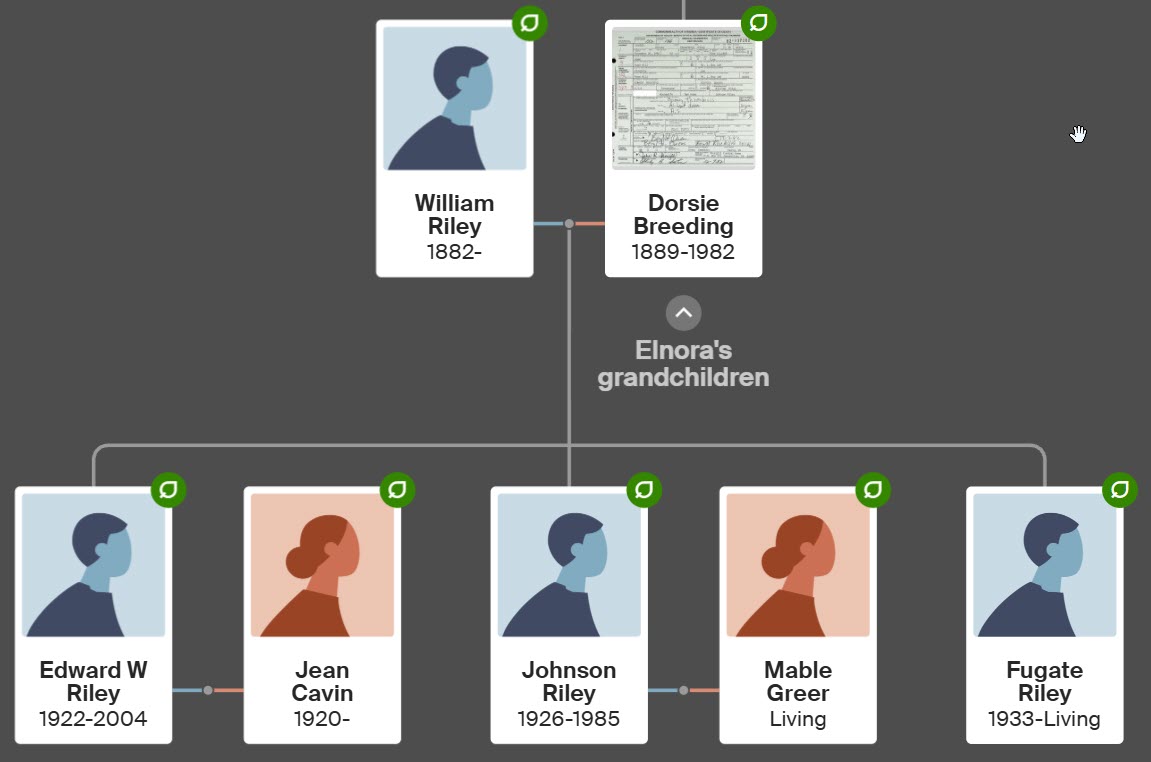
Elenora’s daughter, Dorsie Breeding, married William S. Riley in October, but no year is recorded. They were married by 1920 but had no children at that time.
According to the 1930 Hancock County census, they are shown with two sons, Edd (Edward William) Riley, whose birth is shown in the Bible in 1922, along with another son, Johnson, who was born in 1926 and whose birth is not in the Bible. Edd died in Overton Co., TN in 2004, and Johnson died in 1985 in Rose Hill, VA. Dorsie also had another child, Kinnard Fugate Riley, who was born in 1933 and died in 2018 in Ewing, VA. Only the birth of the first child, Edd, was recorded in the Bible.
Dorsie died in 1982, long after the Bible’s last entry, and she was buried in the Jones Cemetery in Ewing, VA. The McDowell Cemetery was no longer in use by that time.
The Last Burial
James Edward Speer, who died in 1923, appears to be the final burial in the McDowell Cemetery. By 1930, Elnora Speer, James’s daughter, and William Edward Breeding, her husband, had moved to Rose Hill, VA.
This probably explains why there were no more burials after James Edward Speer in 1923. Based on the deed index, some land did pass from William Breeding and wife to to William Riley and Dorsie, but I don’t know if it included the cemetery or when that land left the family. William and Dorsie weren’t buried there when they died in 1955 and 1982, and neither were her parents, who died in 1937 and 1953, respectively.
According to Opal’s letter, the McDowell land, Slanting Misery, was known as the “Edd Breeding Farm” which tells us that he owned the land, but not when he sold it. The fact that it was never known as the William Riley farm suggests that while they may have inherited or purchased the land, it was never known as “their” farm locally. They didn’t live there. Joe Herrell and Mary Opal still owned the adjacent farm in the 1990s. I wish I had asked more questions.
I’m not clear about the later land ownership chain of transactions, but in 1997, Opal said that Bill Brooks owned Slanting Misery and used it for grazing cattle. I can vouch for the cattle grazing part of that. Access was difficult and required a truck to cross the river, and the buildings, except for a barn, were long gone.
My guess is that when William Edward Breeding and Elnora Speer moved to town between 1920 and 1930, they were the last family to live on Slanting Misery, because access was so challenging – and nigh on impossible during the winter weather and spring floods.
The Mystery of the Loose Page
I found a loose sheet of notebook paper stuck between the pages of the Bible that recorded several deaths that weren’t entered on the Bible’s death page. I wonder why. Perhaps the person who wrote on that paper was not physically where the Bible was at the time, or someone found the paper later and thought to put it in the Bible for safekeeping.
On one side of the paper, we find the deaths of three people, all in February of 1910, and all recorded in the same handwriting.
- Patterson Breeding Dide Feb 1, 1910, Age 84 y 4 m 20 d
Based on his death date and age, Patterson was born about September 11, 1825, although exactly how the calculation was performed is uncertain. Patterson Breeding was the father of William Edward Breeding.

This photo was submitted by a family member and is from the book, Hancock County, Tennessee and Its People 1844-1994, Volume II.
Based on their ages, I’d say this was taken between 1895 and 1910, when Patterson died at 84. He doesn’t look to be 84 here, but this photo also appears to have been retouched or perhaps copied.
The other two deaths, which were also in February of 1910, are:
- Tip Chadwell Died Feb. 8, 1910, Age 15 y old
- Rittie Chadwell Died Feb. 12, 1910, Age 38 y old
Given the death dates of Patterson and the Chadwells, I thought sure that they lived in the same community and died in a wave of the flu or something similar, but as it turns out, that’s not the case. The Chadwells lived far from Patterson Breeding. He died in Hancock County and is buried in the Breeding Cemetery, just a couple miles from Slanting Misery.
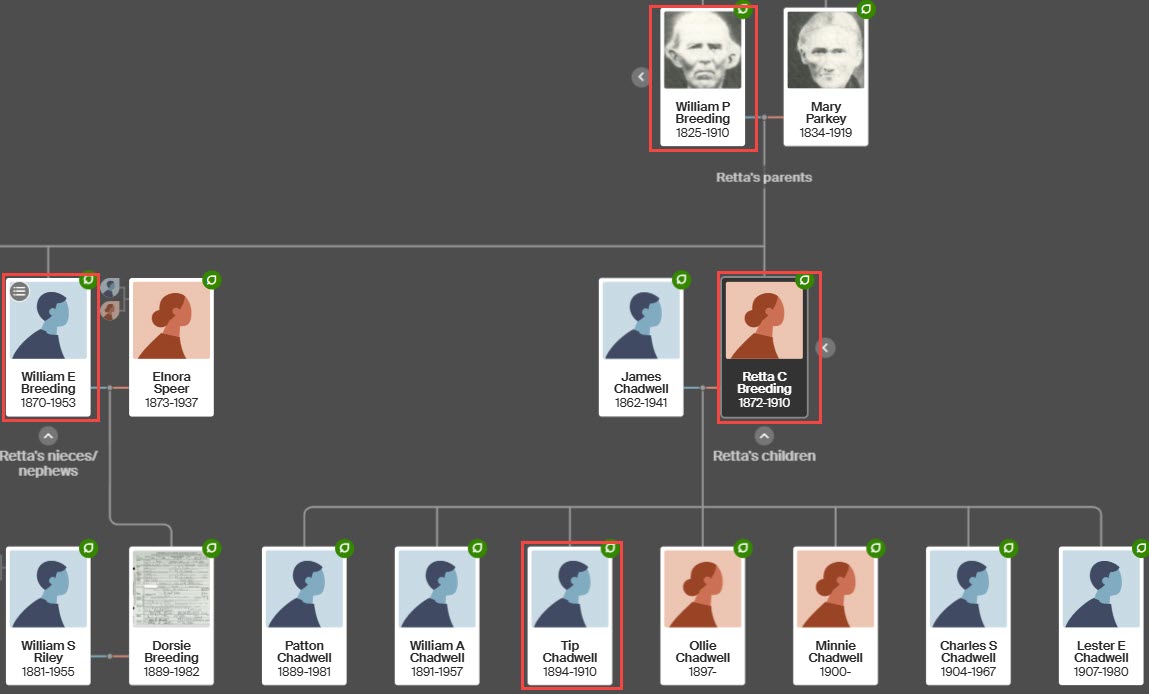
Rittie Chadwell is actually Retta Cornelia Breeding, Edd Breeding’s sister and Patterson Breeding’s daughter. Retta was born on December 5, 1872 in Hancock County. The loose page in the Bible gives her age as 38, although this birth date would make her 37.
Rittie married the Reverend James Chadwell in 1888 and they moved to Missouri about 1895, not long after their son, Tip, whose nickname was Tipie, as carved on his tombstone, was born. Rittie had seven children before she died in February of 1910, just four days after Tipie. Both of their deaths were listed as typhoid, which is highly contagious and typically transmitted through water contaminated with fecal matter.
Tipie’s death certificate says he was 16 years, 6 months, and 23 days old. The notebook page said he was 15. Since his birth wasn’t recorded in the Bible, whoever recorded it on that paper was probably drawing on their memory.
Who wrote this down? Most likely Elenora Speer Breeding. She would probably have sent a letter to Retta to inform her that her father had died, and recorded Retta’s death after receiving a return letter carrying the doubly tragic news.
William Edward Breeding lost his father, sister, and nephew he had not seen since he was a baby, all within 11 days. It must have been a grief-filled time in the Breeding household on Slanting Misery.
There’s information on the other side of that notebook page, too. Someone with different handwriting was calculating Elnora’s age, which was 61 years, and the length of her marriage at 45 years. Typically, this type of calculation was done when someone died, but these numbers subtract to 1934, and Elnora didn’t pass away until 1937, as shown on the Bible page itself.
According to FindaGrave, Elnora isn’t buried in the McDowell Cemetery, but in the Riley Cemetery a mile or so from the McDowell land, along with her husband, William Edward Breeding, who died in 1953, and whose death is not recorded in the Bible.
In 1920, they were living in Hancock Co., TN, near, if not on, the old McDowell place, but by 1930 they had moved to Rose Hill, VA.
The Final Entries
The final entries in the Bible itself tell a sad tale.

On the deaths page, you can three different people’s handwriting. The final 1937 entry is written in a different hand that the 1918 entry, and died is spelled “Dide”.
Elnora Breeding Dide January 23, 1937, then a space, 8.30 AM.
This entry was very clearly recorded by someone very close to her. Someone who was probably sitting by her bedside through the night and knew exactly when she drew her last breath.
Elenora had been the Bible’s custodian for all those years, but then someone penned her death.
Who was it?
I think it was probably Ed Breeding himself, because of two other entries.

On the marriages page, the handwriting changed between the 1889 entry for Elenora Speer’s marriage and the entry for Dorsie Breeding’s marriage, which gives only the month.
Based on the census where Dorsie is living with her parents, and the birth of her first child in February of 1922, she probably married in October of 1920.
Even if entered later, Dorsie clearly knew what day and year she had married, so that new handwriting probably isn’t hers.
The last entry on the marriage page said that “W. E. Breeding and Lillie Vansel was married Aug. 12, 1937” – seven months after Elenora’s death. Vansel is very difficult to read, but additional research helped piece the puzzle together.
Both of those two final marriage entries contain the same unusual “and” sign.

The final mystery is found on the births page where the handwriting changes after Darcy’s 1889 entry. After a gap, Edward William Riley’s 1922 birth appears in the same handwriting as the two final marriage entries. This Edward William Riley is Darcy/Dorsie’s first child.

Below that, and out of birth order, was the single Bible entry I could not figure out. It was hard to read and looked something like Liuil V or N Breeding was born Sept 22, 1891. Just terrible writing.
Lillie Vansu in the marriage record with William Edward Breeding turned out to be Lillie Vansel, except Lillie was a widow and Vancel was her first husband’s surname.
That final “out of birth order” mystery entry on the birth page is not an unrecorded child of W. E. Breeding who was born in 1891 and died before the 1900 census. It’s actually the birthdate of “Lillie V. Breeding,” Edd Breeding’s second wife.
There are no more entries after her birth date was entered, probably at the same time they married, in the same handwriting.
It’s also the same handwriting that recorded the death of Elnora Breeding in 1937, at 8:30 in the morning.
William Edward “Edd” Breeding died at home in Rose Hill, VA, on the last day of September of 1953. He was only ill for four days and died at the age of 82 (or 83 on his death certificate) from pneumonia secondary to heart failure and senility. Who was at his side and reported his death? Dorsie Riley, his daughter, who lived in nearby Ewing, where he was buried in the Riley Cemetery.
William Edward Breeding’s death is not recorded in the Bible, which had clearly fallen out of use and was perhaps tucked away and forgotten by then. At some point, it would have been given to Dorsie and she treasured it as a keepsake, not as the centerpiece of her home.
Edd Breeding’s second wife, Lilly, was about 21 years younger than he was, and she didn’t die until 1966. Her death isn’t recorded in the Bible either.
You might think this is the end, but it isn’t.
But Wait, There’s More
The back of the Bible had pages designed to hold photos or tintypes. And indeed, there were tintypes, but not in the little frames. They were tucked inside the Bible pages with the notebook paper.
Given the Bible’s condition, it’s impossible to tell whether the little paper frames that held some of the tintypes came from the back of the Bible, but I suspect they did.
Tintype photography came into common usage after the Civil War and pictures were often taken by traveling photographers operating out of covered wagons.
Tintypes are photographs formed directly on a thin sheet of iron coated with a dark lacquer.
The shift to paper-based photography occurred between 1880 and 1910, although they overlapped with tintypes for decades. My Estes ancestor was attending people’s family reunions in that area with his big black camera by 1900 and taking photos to sell to family members.
So, who are these people in the photos and tintypes?
Guess how many of these images have any names? If you said “zero,” you’d be accurate.
But we have clues based on the images themselves, and the names recorded in the Bible. We know who owned the Bible, and we also know who lived on Slanting Misery thanks to a myriad of clues.
Let’s see if we can unravel these final puzzle pieces.
Bible Photos and Tintypes
I have not used AI to alter these images. My only modification was to lighten the tintypes somewhat after scanning.
McDowell Bible Photo – Probably William Patterson Breeding

This adult male appears to be roughly 45 to 50 years old, with salt-and-pepper hair and a fully grey beard. His skin is in great shape, and the rest of his facial features do not look elderly. If this was taken in the 1870s or even 1880, this man would have been born roughly between 1820 and 1835. Based on his facial structure, and the two photos we have of Patterson Breeding and James Edward Speer, I think this is a younger Patterson Breeding, taken in the 1870s. It almost certainly is not James Edward Speer. This man’s face is angular and his cheeks have been colorized by the photographer.
His loose-fitting “sack coat” was the everyday uniform for working men from the 1860s through the 1880s, although I doubt it was for farmers in Appalachia. This coat was probably his Sunday best, with a matching vest buttoned high over a white shirt. His hairstyle and full beard suggest the 1870s.
The exposed metal edges of this tintype are rusting. Photographers often clipped the corners so the tintype would fit in a case or album.
McDowell Photo – Probably Elenora Speer

This female child appears to be 5-7 years old. Based on tintype dates, and another photo of this same person a few years later, this is very probably Elenora Speer.
She wore a wide belt and rectangular buckle over a dark dress, with a white ruffled collar and large red bow. The bow and her rosy cheeks are hand-tinted, a common practice to make the images look more lifelike. Sometimes metal buttons and buckles are flecked with gold paint, but hers do no seem to be.
Girls in that era often wore smaller versions of the structured dresses worn by fashionable older women.
Her hair is swept back and held in place by a dark ribbon or headband.
These details suggest the 1870s.
I can see the McDowell women sitting outside their cabin, or inside by candlelight, sewing their clothes for these photos.
Having photos taken was maybe a once-in-a-lifetime event.

This young lady looks to be between 10 and 12. If she is Elenora Speer, born in 1873, the photograph would date to about 1883-1885.
She doesn’t look very happy, probably because she was told to hold perfectly still and not to move a muscle.
Her small hat made me smile. What child wouldn’t have loved that, topped with what looks like feathers, flowers, or a fabric pom-pom? These topper hats were considered high fashion in the late 1870s and early 1880s. Her wide white lace collar and blue shoulder bow add to her dressed-up appearance, although it looks like she might be wearing an older relative’s clothes, as they are a bit large for her. Her elbow rests on a pedestal draped with a fringed plaid shawl, which may have helped her remain motionless for the photograph.
Her cheeks have been colored, along with the bow and whatever is on the top of her hat too.

This photo of an adult female is tiny, maybe 1.5 inches by 1.75 inches. Photographers introduced these miniature formats in the 1880s and they were popular into the 1890s.
Her high collar, edged with white lace and fastened with an oval brooch or cameo, offers another clue to the photo’s date. The closely spaced buttons down her bodice and her short, curled bangs, with the rest of her hair pulled back, also suggest the 1880s.
She looks to be roughly 20-35 years old in this picture, although it’s difficult to tell. Candidates would have been:
- Elnora Speer, born in 1873, age 20 in 1893
Other candidates are Elnora’s mother and aunts:
- Matilda McDowell, born in 1829, died in 1888 at age 58
- Surena McDowell, born in 1826, died in 1893 at age 67
- Caroline McDowell, born in 1830, died in 1899, was 63 in 1893
The woman in this photo looks to be maybe 20-35, and the McDowell sisters would all have been over 50 in 1885. Matilda died in 1888 and Surena in 1893, so if this photo was taken after 1893, it had to be either Caroline McDowell, or Elenora Speer.
Given that this was not a tintype, it’s probably printed somewhat later. Given that she looks to be a younger woman, my bet would be that this is Elnora Speer. Compared with two earlier tintypes, this appears to be the same person. Look closely at her eyebrows. Notice the wide nose bridge shared with John McDowell.
If this was printed in 1893, Elnora would have been 20, Matilda was deceased and Surena died that year. If this was printed in 1900, all three McDowell women had died and only Elenora was left.
The fact that the Bible descended through Elnora might suggest that this is her too, but she might well have cherished the photo of one of her McDowell aunts who continued to raise her after her mother died.
Given this woman’s age and resemblance to the two earlier tintypes, I think it’s Elnora Speer.
McDowell Bible Photo – Probably William Edward Breeding

This tintype, probably taken in the 1870s or maybe 1880s, shows a boy about 9-12. His dark, open jacket over a light button-front shirt suggests the 1870s. His short hair is neatly parted and brushed across his forehead.
This tintype is out of focus and does not look to be of the same quality as the other tintypes. The dark, spidery lines near his head and across his shirt are faults in the tintype’s protective coating.
Based on the fact that William E. Breeding was born in 1870, this suggests that this photo is a young William Edward Breeding who would marry Elenora Speer in 1889.

This young man looks to be in his late teens to maybe 20 in the late 1880s, and appears to be the same person shown in the photo, above. The face, ears and especially his left eye look the same.
His high-buttoned sack coat with its narrow lapels and the matching vest suggest the mid-to-late 1880s. Notice the small stud or button beneath his white collar. Short bangs combed across his forehead were popular among teenagers in the late 1880s and early 1890s, so he was quite fashionable. Hands were often clasped to help subjects remain motionless for the photograph.
McDowell Photo – Probably Darcy Breeding

This photo, mounted on stiff cardstock with scalloped edges, is of a young female who appears to be about 12 years old and was likely taken around 1900.
Based on the age of this girl in the photo and the births in the Bible, this could well have been Darcy Breeding, who was born in 1889. Of all the photos, this is the only one taken outside, and if it’s Darcy, this could well have been taken on Slanting Misery, or maybe at church if this was a community photography event.
Her light-colored dress has softly puffed sleeves, a style that continued to be worn into the early 1900s. The shorter skirt with dark stockings and leather boots suggests a young girl. Adult women of that era wore floor-length dresses.
Unlike the tintypes, this photograph is printed on paper, with a matte or semi-matte finish and scalloped edges. These were very popular after 1890.
Fate Has a Sense of Humor
It was on Edd Breeding’s death certificate that I discovered that his second wife wasn’t Lina, Lucy or Liuil V or N Vansu.
Are you ready for this?
It’s Lilly Campbell.
Say what?

Yes indeed, the widow Vancel was a Campbell by birth.
My mouth fell open!
Right about then, I was certain I was going to have to pack that Bible back up and send it right back to my Campbell cousins.
But wait.
It gets even stranger.

On their marriage license, Lilly’s parents are given as Nelson Campbell and Martha Lewis.
Nelson Campbell, who married Martha Lewis, is in the MY Campbell line.
But you’re probably thinking: So what’s the big deal? Your Campbell cousins sent you the Bible – it’s all the same Campbell line, right?
Well, not exactly. But kind of yes.
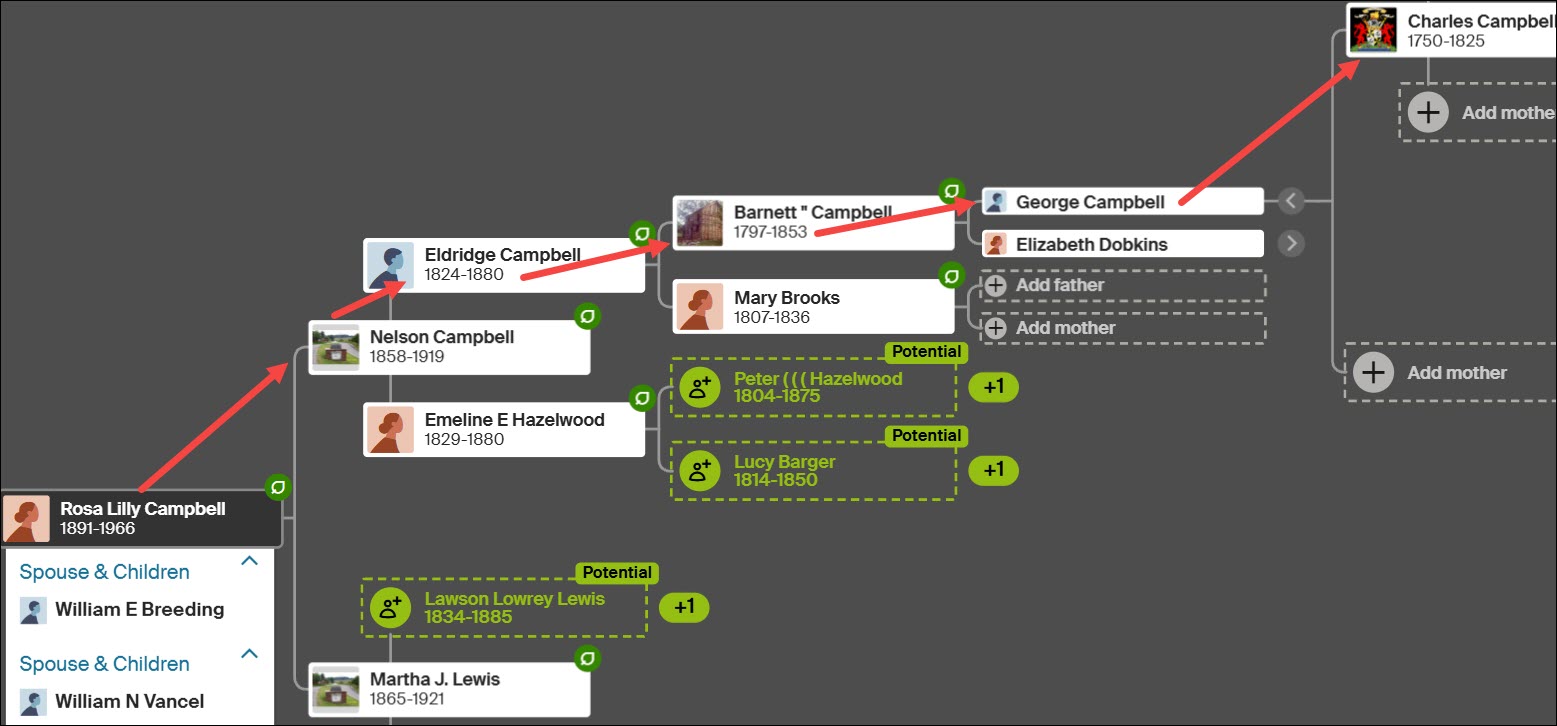
You see, Nelson Campbell is the great-great-grandson of my brick-wall Charles Campbell, who we think descends from the Augusta County, VA Campbells.
Campbells are complicated.
Thankfully, both my Campbell cousins and men from my Campbell line have tested their Y-DNA. We’re related, of course, but our common ancestor is not in America.

Even though the ancestors of my Bible-rescuing Campbell cousins from Lee County, Virginia were living right across the border from my Claiborne County, TN Campbells, this Y-DNA haplogroup timeline places our shared paternal ancestor around 1350 CE, back in Scotland.
Once a Campbell cousin, always a Campbell cousin.
Back in 1350, Sir Archibald Campbell had succeeded his father, Sir Colin Campbell, and his main activities revolved around feuding with his brother, Dougall Campbell, and the neighbors near beautiful Loch Awe in the Scottish Highlands, which reminds me an awful lot of Appalachia. Some of those neighbors were the MacDougall clan, who may have been the ancestors of the McDowell line. Or maybe not. The MacDougalls and McDowells are tear-your-hair-out complicated too.
Regardless, we’ve come full circle now, and no one is feuding anymore.
Thank you, my dear Campbell cousins, for rescuing the McDowell family Bible from oblivion.
_____________________________________________________________
Share the Love!
You’re always welcome to forward articles or links to friends and share on social media.
Subscribe!
If you haven’t already subscribed, it’s free. You’ll receive an e-mail whenever I publish by clicking the “follow” button at the top of the main blog page, here.
Help Keep This Blog Free
I receive a small commission when you click a vendor link in my articles and purchase that item. This does NOT increase your price but helps me keep the lights on and this informational blog free for everyone. Please click on the affiliate links in the articles or to the vendors below if you are purchasing products or DNA testing.
Thank you so much.
DNA Purchases and Free Uploads
- FamilyTreeDNA – Y-DNA, mitochondrial and autosomal DNA testing
- MyHeritage DNA – Autosomal DNA test
- AncestryDNA – Autosomal DNA test
- AncestryDNA Plus Traits
- 23andMe Ancestry – Autosomal DNA only, no Health
- 23andMe Ancestry Plus Health
Genealogy Products and Services
- MyHeritage Subscription with Free Trial
- Legacy Family Tree Webinars – Genealogy and DNA classes, subscription-based, some free
- Legacy Family Tree Software – Genealogy software for your computer
- OldNews – Old Newspapers with links to save to MyHeritage trees
- MyHeritage Omni comprehensive “everything included” subscription plan
- Newspapers.com – Search newspapers for your ancestors
- NewspaperArchive – Search different newspapers for your ancestors
My Books
- DNA for Native American Genealogy – by Roberta Estes, for those ordering the e-book from anyplace, or paperback within the United States
- DNA for Native American Genealogy – for those ordering the paperback outside the US
- The Complete Guide to FamilyTreeDNA – Y-DNA, Mitochondrial, Autosomal and X-DNA – for those ordering the e-book from anyplace, or paperback within the United States
- The Complete Guide to FamilyTreeDNA – Y-DNA, Mitochondrial, Autosomal and X-DNA for those ordering the paperback from outside the US
Genealogy Books
- Genealogical.com – Lots of wonderful genealogy research books
- American Ancestors – Wonderful selection of genealogy books
Genealogy Research
- Legacy Tree Genealogists – Professional genealogy research